Amazon Ads
Why is my book not selling on Amazon? Find the broken step
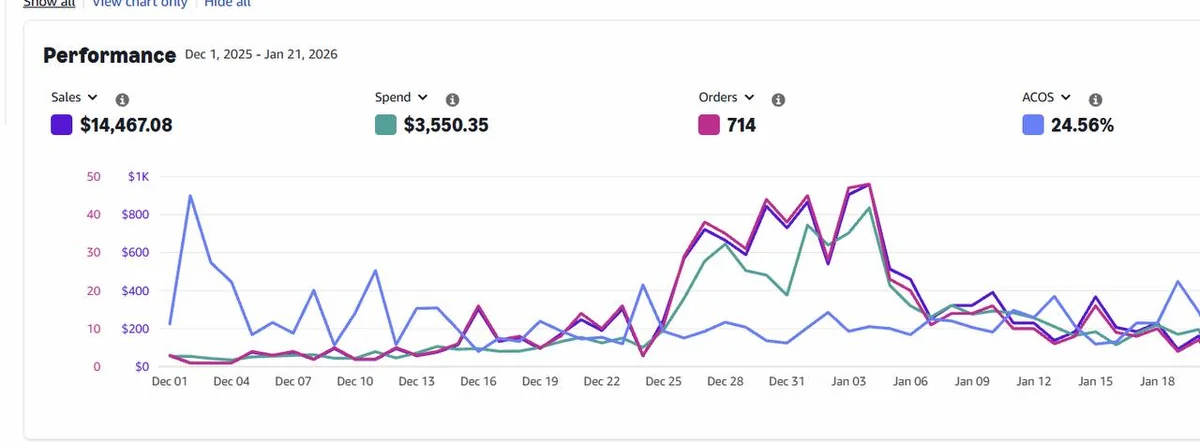
A book usually doesn't sell on Amazon for one of four reasons: nobody sees it, people see it but don't click, they click but don't buy, or it sells at a loss. Each shows up in a different number in your Amazon Ads report. Below: how to find the broken step in two weeks of data, what to fix at each one, and three of our books that we pulled up, with real numbers.
First, find where the buyer gets lost
The path from being seen to being bought has four steps:
Impressions → Clicks → Product page → Purchase
At every step some people drop off. That's normal. What's not normal is when almost everyone drops off at one step. That step is the one to find.
So the first rule of diagnosis: don't change anything until you know which step is broken. A new cover won't help if nobody sees the book in the first place.
That's the difference between diagnosis and "let's try changing something". You're not looking for things to improve — everything can always be improved. You're looking for the one step where most people are lost, and you work only on that. The other steps can wait: while a lower step is broken, fixing the ones above it does nothing.
What we look at in our own accounts when a campaign spends more than it brings in — and in what order. Leave your email and we'll send it.
One email a week at most. Unsubscribe in one click.
Before the funnel: three quick checks
Most "why is my book not selling" articles start with a list of things to try. We'd rather rule out the boring causes in five minutes first.
- Is the book actually live, in every format you published? On your KDP Bookshelf, check the status of the eBook, paperback and hardcover. Then search Amazon for your exact title to confirm the formats are linked on one page.
- Are you running Amazon Ads at all? A new book from a new author gets very little organic visibility. Without ads, the numbers below don't exist, and the honest answer to "why no sales" is often "nobody has seen it yet". Even with ads on, part of your sales will come without an ad click — here's how to count them: organic vs ad sales on KDP. How much budget that takes: how much it costs to self-publish on KDP.
- Is there demand for the topic? If very few people search for it, no cover or ad will fix that. More on that in the last sections and in how to find a profitable KDP niche.
Four numbers from your Amazon Ads account
Everything you need is in your campaign report in Amazon Ads. Use at least two weeks of data: over a shorter period the campaign is still finding its audience and the numbers don't mean much.
| Metric | What it shows | Warning sign (our benchmarks) |
|---|---|---|
| Impressions | how many times the book was shown | under a few hundred a week |
| CTR | share of people who saw it and clicked | below 0.3% |
| Conversion | how many clicks it takes to get a sale | more than 10 clicks per sale |
| ACOS | ad spend as a share of ad sales | above your book's break-even ACOS |
Read them together, not one at a time: it's the combination that shows where the leak is. A low CTR on its own means nothing. A low CTR with lots of impressions means the cover or title doesn't grab people. The same low CTR on 300 impressions a week means nothing at all — there's not enough data.
If you don't have two weeks of data yet, wait. It's the cheapest part of the whole process.
Step 1: few or no impressions
What it means. People don't see the book. The problem isn't the cover, the description or the price — buyers haven't gotten that far.
Where to look:
- Keywords. Amazon doesn't understand which searches to show the book for. Check your seven KDP keyword boxes and your campaign keywords — how to choose and clean them up.
- Bids too low. You're simply not winning auctions. This is the most common cause for beginners who set $0.20 bids "so as not to waste money".

In this screenshot the bids are $0.51 and $0.21. The budget really isn't being spent — but the book isn't selling either: in three days it was seen 157 times. For comparison, a working campaign of ours gets tens of thousands of impressions a week.
- Niche. If few people search for the topic, there won't be impressions at any bid. This is the worst case, because only a new book fixes it.
What to do. Keywords first, then bids. If impressions still don't come, check the niche itself: how to find a profitable KDP niche.
The fastest way to tell whether it's keywords or bids is to look at where the book ranks. AuthorLens, an analytics dashboard made only for Amazon KDP, tracks a book's position daily for up to 500 keywords. If the book sits on page five for its main keyword, buyers never reach it, however good the cover is.
We use AuthorLens daily and have a business relationship with it.
Step 2: impressions, but no clicks
What it means. A shopper saw the book in the results and scrolled past. They had exactly three things in front of them: cover, title and price.
So the cause is always one of those three.
Cover. The most common culprit. In search results it's the size of a postage stamp. If the title isn't readable at thumbnail size and the image turns into a blur, nobody clicks. Look at your book next to competitors at thumbnail size, not full screen.
Title. It doesn't say what's inside or who it's for. "Meal Prep Cookbook" vs "Meal Prep Cookbook for Beginners: 100 Recipes Under 30 Minutes" — the second tells a shopper whether it's for them.
Price. If you're twice the price of competitors and the thumbnail doesn't justify it, there's no click. Check whether a profitable price is even possible in your niche: KDP royalties explained shows what's left after printing.
What to do. This is the cheapest step to fix: we pay a cover designer around $100, and a new cover can change CTR several times over — how to make a KDP book cover that sells. The title is a different story: some book details are locked once a book is published. Check what you can't change after publishing on KDP before you plan a retitle.
Step 3: clicks, but no sales
What it means. A shopper opened the book's page and left. The page didn't convince them.
What to check, in order:
- The first reviews. One negative review at the top can wipe out your conversion. Read what it says: often it's something you can fix — small print, too few examples, poor print quality. Where first reviews come from, and what's allowed: how to get book reviews on Amazon.
- The description. It's written for a person, not an algorithm. Only the first couple of lines show before "Read more" — they decide.
- A+ Content. Without it, your page looks empty next to competitors.
- Look Inside. Amazon shows the first pages. If that's three pages of table of contents and an empty foreword, the shopper closes the tab.
- Price next to competitors. Not just "expensive", but expensive for no visible reason.
What to do. The description, A+ Content and price can be changed at any time for free — how to publish a book on Amazon KDP shows where each one lives. Start there.
Step 4: sales, but no money
What it means. The trickiest case: the reports look good, orders come in, and the bank account is empty.
The cause is that ACOS is above your break-even point.
Break-even ACOS is simple: royalty ÷ price × 100. For a $24.99 paperback earning $10.98 in royalty, that's about 44%.
While your actual ACOS is below that, you're making money. Above it, every sale loses money, and more sales only dig the hole deeper.
What to do:
- Work out your book's break-even ACOS in our KDP royalty and break-even ACOS calculator — the full explanation with examples is in Amazon Ads for authors: profit, not ACOS
- Pause keywords with ACOS above break-even and few sales — or add negative keywords if a keyword brings both good and junk traffic
- Lower bids where there are lots of clicks and no conversion
- Check whether your price is too low: sometimes raising the price pays better than cutting ads
- Check your bidding strategy and placement adjustments: with dynamic bids up and down, extra percentages stack and clicks cost more than you think
Keep in mind that the KDP dashboard doesn't show ad spend, so "sales, but no money" is easy to miss. Why, and how to see profit per book: KDP sales dashboard.
The most expensive diagnosis mistake
Changing everything at once.
New cover, rewritten description, different keywords, new bids — all on one day. Two weeks later sales have changed, and you don't know what worked. Or they haven't, and you don't know what didn't.
Do it this way instead: one step, two weeks, a conclusion. It's slower, but you build real knowledge of your book instead of guesses.
The second most expensive mistake is raising and lowering bids every day. Amazon needs time to learn whom to show the book to. Constant changes reset that, and the campaign never finds your audience.
And the third, the quietest one: drawing conclusions from one week. A week is usually a few dozen clicks — numbers that will be different next week by pure chance. Two weeks is the minimum to see a trend.
Three books we pulled up
Three cases: two from our own accounts, one from a client. Each had its problem at a different step of the funnel, and each needed a different fix.
The book that only needed better ads
Published in April 2025. For a year it sold steadily: $700–1,500 in royalties a month. Not a failure, but not what we'd hoped for.
In May 2026 we audited and rebuilt its ads. The result for the month:

$3,309 in royalties vs about $1,400 in April — 2.4 times more. Not a single page of the book changed: only the ads.
This is the simplest case. The problem was at steps 1 and 4 — impressions and ACOS — and the book itself worked.
The book that took a year
Here there was no quick answer.

For nine months the chart sat almost at zero. Not because it wasn't advertised, and not because the niche was bad. The book just didn't sell, and we had to find out why.
What we did all that time. We changed the cover about ten times. We rewrote the listing. We redid the A+ Content. Each change was tested and checked against the numbers.
That's funnel diagnosis in practice: not one brilliant guess, but checking the steps one after another. Cover and title are step 2; listing and A+ Content are step 3. We changed one thing at a time and watched which number moved.
From May 2026 the book took off:

Lifetime: $9,936.29 in royalties, $6,934.92 on ads, $3,001.37 net. ACOS of 45.82% is high, and there's room to bring it down. But the book went from zero to a best seller in its category:

217 copies in 24 days — about nine books a day.
The book where the problem wasn't the book
The third case is harder than both, because the funnel has nothing to do with it.
We'd written two books on the same topic on different accounts, and both made $2,000+ net a month. The logic was obvious: the topic works, let's do a third.
The third made $15,728 in royalties in a year — about $1,300 a month. But ads ate $9,991 at 50.17% ACOS, leaving $5,737 net, under $480 a month.
The book sells, it gets almost 1.8 million impressions, orders come in — yet the profit is thin, because every buyer now costs about twice what it should.
That's not a funnel problem. That's demand fading in the niche. How to check a niche before you write: how to find a profitable KDP niche.
The lesson: before you cycle through covers, check whether the niche itself has changed.
What this means for your book
A year is a normal timeline for a difficult book. Not for every book, but it happens. Three months without results isn't a reason to give up on a book; it's a reason to check the next step of the funnel. What a realistic target looks like in sales per day: your first $1,000 on KDP.
Ten covers aren't wasted work. Each one answered "not this". Nine "not this" answers are worth as much as one lucky guess — they just take longer.
But first, check what's actually broken. The three books above had three different diagnoses: ads, listing, niche. Had we treated any of them with the wrong fix, none would have moved.
If the book used to sell and then dipped, check whether it slipped in search for its main keywords. How to see that the same day is in Amazon Keyword Rank Tracking for Books.
Don't want to deal with ads yourself? Campaign setup and ongoing management can be handed to an ads specialist we trust — message him on Telegram @Lamgr_557359.
When a book isn't worth saving
Sometimes the honest answer is to let it go.
If the book gets impressions, the cover is fine, the listing has been rewritten and conversion still isn't there, the problem may be the niche or the book itself. Then another $500 on ads is worse than putting what you learned into the next book.
Signs a book isn't worth saving: every competitor in the niche has a BSR (Best Sellers Rank) above 100,000, your book loses on page count and price, and the negative reviews are about the content, not the design. Checking a niche by the numbers takes five minutes — here's the checklist — against months of work.
That's not defeat. It's months saved.
FAQ
Why is my book not selling on Amazon at all?
Start with impressions. If the book is barely shown, the problem isn't the book but visibility: keywords, bids that are too low, or a niche with little demand. Changing the cover or description at this stage won't help.
Which numbers show why a book isn't selling?
Four numbers from your Amazon Ads campaign report: impressions, click-through rate, conversion (clicks per sale) and ACOS. Read them together over at least two weeks; the combination shows where buyers are lost.
My book gets impressions but no clicks. What's wrong?
In search results a shopper sees only the cover, the title and the price, so the cause is one of those three. Compare your thumbnail with competitors at actual size. A new cover is usually the cheapest fix and can change click-through rate several times over.
My book gets clicks but no sales. What should I fix?
The product page isn't convincing. Check the first reviews, the opening lines of the description, A+ Content, Look Inside and your price next to competitors. The description, A+ Content and price can be changed at any time.
How long should I wait before changing something?
At least two weeks of data per change. Change one thing at a time, otherwise you won't know what worked. One of our books needed only new ads and grew 2.4 times in a month; another took a year and about ten covers.
Royalties and ad spend per book, side by side — the way we track our own books. It also shows the highest ACOS each book can afford. Leave your email and we'll send it.
One email a week at most. Unsubscribe in one click.
Real campaign numbers, not theory. One recent case: the same keyword in two match types — broad at 9% ACOS, exact at 49%. In the Facebook group KDP Ads & Profit we break down cases like this every week.
Join the group →or follow Darya on LinkedIn

Selling books on Amazon KDP since 2023, 77,600+ copies sold. Every number in these articles comes from our own KDP and Amazon Ads accounts.
All articles