Profit & analytics
KDP royalties explained: what you actually earn per copy
KDP pays 70% or 35% on Kindle eBooks and 60% (or 50% under $9.99) of the list price minus printing on paperbacks sold on Amazon.com. For a 75-page color paperback at $24.99 that's $10.98 a copy. Below: every KDP royalty rate with sources, the fees that shrink it, and what's actually left after Amazon Ads.
KDP royalty rates at a glance
A royalty is your share of each sale. KDP has three models, and which one applies depends on the format. This guide is only about the money from one copy; the whole path from niche to first sales is in how to sell books on Amazon KDP.
All rates below are from KDP Help as of September 2026, for sales on Amazon.com:
| Format | Royalty | What's deducted |
|---|---|---|
| Kindle eBook, 70% option | 70% of list price (without VAT) | Delivery fee: $0.15 per MB |
| Kindle eBook, 35% option | 35% of list price (without VAT) | Nothing |
| Paperback, list price $9.99+ | 60% of list price | Printing cost |
| Paperback, list price $9.98 or less | 50% of list price | Printing cost |
| Hardcover | 60% or 50%, same principle | Printing cost (higher than paperback) |
| Paperback, Expanded Distribution | 40% of list price | Printing cost |
Sources: eBook royalties, eBook list price requirements, paperback royalty, hardcover, Expanded Distribution.
Now each one in detail.
eBook royalties: 70% or 35%
When you get 70%
70% is the better option, but you only get it when several conditions are met at once (KDP Help):
- List price between $2.99 and $12.99 on Amazon.com. The top of the band went up from $9.99 to $12.99 effective July 7, 2026. Books already priced between $9.99 and $12.99 are not moved to 70% automatically: KDP says your current price and royalty option stay the same unless you change them, so switch the option yourself in Rights & Pricing. Other marketplaces have their own bands in local currency. The rest of this year's changes are in KDP rule changes in 2026.
- The sale happens in a 70% territory. The list includes the US, Canada, the UK, Australia, New Zealand, India, Japan, Brazil, Mexico, Germany, France, Italy, Spain, the Netherlands, Belgium, Austria, Switzerland, Ireland, Luxembourg and a number of others. Sales outside the list pay 35% even if your book is on the 70% option. The full list is on KDP Help.
- The eBook is at least 20% cheaper than any print edition of the same book on Amazon.
- The book isn't made up of public domain content. A public domain work without your own contribution only qualifies for 35%.
Delivery fees: why file size is money
This is the part beginners usually discover after the first payments. On the 70% option, KDP deducts a delivery fee from every sale, based on the file size.
Rates per megabyte (KDP Help): $0.15 on Amazon.com and CAD $0.15 on Amazon.ca, £0.10 on Amazon.co.uk, €0.12 on the German, French, Spanish, Italian and Dutch stores. The minimum is one cent.
An example. A plain-text book is about 1 MB — $0.15 per sale, which is nothing. An illustrated book with heavy images easily hits 10 MB — that's $1.50 off every copy. Over a thousand sales, that's $1,350 lost for no reason.
Two things to know:
- The size that counts is the size after KDP converts your file. A 19 MB upload can end up as 5 MB. Go by the size KDP shows after conversion, not the file size on your computer.
- There's no delivery fee on the 35% option. For very heavy illustrated books, work out both: sometimes 35% with no fee leaves more than 70% minus $1.50 a copy.
How to cut file size: compress images before upload, don't embed print-resolution pictures, and upload EPUB rather than PDF. More on the eBook format in how to sell eBooks on Amazon KDP.
Kindle Unlimited page reads
If your eBook is enrolled in KDP Select, you also earn from Kindle Unlimited. That isn't a percentage: KDP sets a monthly KDP Select Global Fund, and each author gets a share of it proportional to their share of all pages read (KDP Help). The per-page rate changes every month, which is why KENP royalties (KENP is Kindle Unlimited pages read) in your reports are estimates until the month is finalized.
Paperback royalties: 60% minus printing
The main model for paperbacks and hardcovers sold on Amazon (KDP Help):
Royalty = (royalty rate × list price) − printing cost
On Amazon.com the rate depends on the list price:
- $9.99 and above — 60%;
- $9.98 and below — 50%.
Ten percentage points on every sale. That makes $9.99 not just a round number but a threshold you rarely want to go below. Other marketplaces have similar thresholds in their own currencies.
What printing costs on Amazon.com
Printing is paid out of each sale, not upfront. KDP publishes the formulas on its printing cost page. For paperbacks on Amazon.com:
| Ink | Trim | Pages | Printing cost |
|---|---|---|---|
| Black | Regular | 24–108 | $2.30 flat |
| Black | Regular | 110–828 | $1.00 + $0.012 per page |
| Black | Large | 24–108 | $2.84 flat |
| Black | Large | 110–828 | $1.00 + $0.017 per page |
| Standard color | Regular | 72–600 | $1.00 + $0.0255 per page |
| Standard color | Large | 72–600 | $1.00 + $0.0402 per page |
| Premium color | Regular | 42–828 | $1.00 + $0.065 per page |
| Premium color | Large | 42–828 | $1.00 + $0.08 per page |
Large trim means more than 6.12 inches wide or more than 9 inches tall — an 8.5×11 book is large trim, a 6×9 book is regular.
What this means in practice:
Page count. The thicker the book, the higher the printing cost. Our usual target is around 75 pages. A common beginner mistake is a 150–300-page color book that leaves nothing after printing.
Ink. Black ink is much cheaper than color. Color only makes sense where it truly matters — cookbooks, for example.
Trim size. 6×9 is the standard and the cheapest per page; 8.5×11 costs more because it's large trim.
Paperback vs hardcover. Hardcover has a higher fixed printing cost and fewer buyers. On our accounts about 90% of sales are paperbacks.
Expanded Distribution: 40%
A separate checkbox when you publish a paperback. It makes the book available beyond Amazon — to bookstores, libraries and wholesale distributors. The formula (KDP Help):
Royalty = 40% × list price − printing cost
For a $24.99 book with a $4.02 printing cost that's about $5.98 instead of $10.98 — nearly half. The reason: in this channel the buyer is a middleman who also needs a margin.
Turn it on or not
Our rule: turn it on, but plan on 40%, not 60%. Sales through these channels are small and unpredictable — an add-on to Amazon, not a second Amazon. Don't build your numbers on them.
There's one reason not to skip it: you don't pay for ads on those sales. On Amazon most sales are pushed by ads, which take 30–50% of royalties. In Expanded Distribution there are no ads. So $5.98 there is $5.98 net, while $10.98 on Amazon turns into roughly $5.50–7.70 after ads. On paper the gap is almost double; in practice it nearly disappears — and the channel costs nothing.
ISBN and format limits
The free KDP ISBN doesn't block Expanded Distribution. KDP Help says it plainly: "The paperback can have an ISBN you bought or one assigned by KDP." The limit of the free ISBN is different: you can only use it with KDP, not to publish the same book elsewhere (KDP Help).
Hardcovers aren't eligible — paperbacks only. Also excluded: paperbacks with frequent lined or blank pages (journals, notebooks, planners, calendars), plus workbooks, activity books and coloring books. If the checkbox is greyed out, this is usually why.
KDP royalties in real money
Here is one real book: 75 pages, 8.5×11 inches, standard color, sold on Amazon.com.

The math: $24.99 × 60% = $14.99, minus $4.02 printing = $10.98 per copy. The same book in black ink prints for $2.84 and earns $12.15.
Now add ads. These are our own averages, not Amazon rules:
| Value | |
|---|---|
| List price | $24.99 |
| Printing cost | $4.02 |
| Royalty per copy | $10.98 |
| Cost per click (CPC) | $0.80 |
| Clicks per sale | 6–8 |
| Ad cost per sale | $4.80–6.40 |
| Net per ad-driven sale | $4.58–6.18 |
Technically you're profitable as long as a buyer costs under $10.98. In practice, aim to keep it at $5–6, or nothing is left.
Don't forget organic sales
Not every sale comes from an ad. On our books 20% to 50% of sales are organic — the buyer found the book in Amazon search. You pay nothing for those, and the whole $10.98 is yours. Where that share comes from and how it grows: organic vs ad sales on KDP.
That changes the math. Two scenarios:
100 sales a month (about three a day):
- 80 via ads × $4.58–6.18 = $366–494
- 20 organic × $10.98 = $220
- Total: $586–714 net from one book
500 sales a month (about sixteen a day):
- 400 via ads × $4.58–6.18 = $1,832–2,472
- 100 organic × $10.98 = $1,098
- Total: $2,930–3,570 net
Notice that organic sales are only a fifth of the copies but bring about a third of the net: 20 organic copies earn as much as 36–48 ad-driven ones. So the job of an ad campaign isn't only to sell today; it's to lift the book in organic search. Ads that never lead to organic sales are running on empty.
To see which sales came from ads and which were organic, we use AuthorLens, an analytics dashboard made only for Amazon KDP: it splits organic and ad sales by book, format and day, shows net profit per book after ads, and tracks your book's rank for up to 500 keywords daily — so you can see whether ads are actually lifting it.
We use AuthorLens daily and have a business relationship with it.
Break-even ACOS: when ads still pay
The one number worth knowing for every book. Amazon Ads defines ACOS as ad spend ÷ ad revenue × 100, and ad revenue is counted at list price. Your break-even point:
Break-even ACOS = (royalty ÷ list price) × 100
For our example: ($10.98 ÷ $24.99) × 100 = 44%. Below 44% ACOS, ad sales are profitable; above it, you lose money on them even if sales look great.
Look how much printing matters. In black ink the royalty is $12.15, and break-even ACOS rises to 49% — a black-and-white book can carry noticeably more expensive ads.
You can calculate break-even ACOS for your own book, together with how many sales you need for your goal, in our KDP royalty and break-even ACOS calculator. Why ACOS alone can mislead you: Amazon Ads for authors: judge by profit, not ACOS.
What margin to build in
Start from what you keep, not from the price.
Our floor is $7.25–10 per copy after printing. A smaller margin can't carry ads: the cost of each buyer eats the profit and the book runs at zero.
So set the price to fit the margin, not the other way round. For a standard 75-page paperback that usually means $22–25. Check your own book in the KDP royalty calculator — printing cost depends on page count, ink and trim size. If you sell in several marketplaces, check each one: printing costs and royalties differ.
You'll also need the KDP cover calculator, which sizes the cover including the spine from page count, paper type and trim. Spine width depends on the paper, so changing the print type means a new cover file.
When KDP pays your royalties
KDP pays royalties about 60 days after the end of the month in which the sale was reported; Expanded Distribution royalties take about 90 days. Sales in January are paid by the end of March. Direct deposit has no minimum payment threshold; wire transfers and checks require $100 or the equivalent. Paperback sales show up in KDP reports within 14 days; what each report shows is in KDP sales dashboard.
That delay matters for planning: ad spend is charged as you go, while royalties arrive two months later. We count it into every launch budget — see how much it costs to self-publish on KDP.
The other upfront line is the book itself: about $1,000 for the text in 2026 if you hire a writer, or nothing but your time if you write it yourself.
What royalties add up to over time
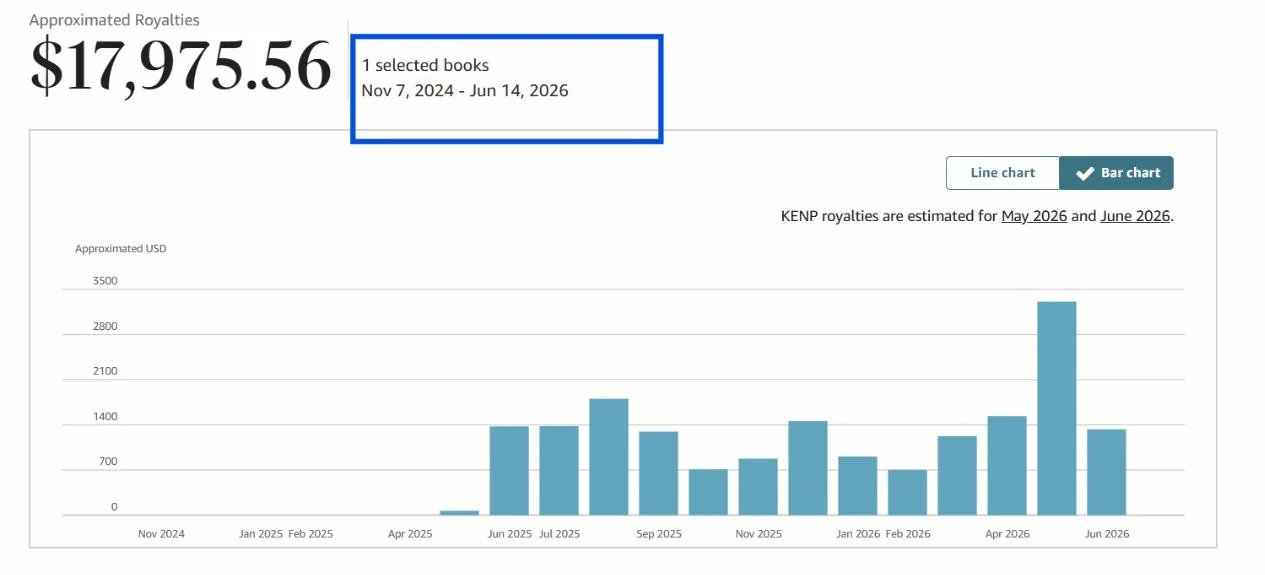
Small per-copy numbers do add up. In our reports one book earned $9,992 in royalties over a year and a half, another $17,975 over about the same period — that's the screenshot at the top of this page. But that's years of work, not weeks, and those are royalties, not profit: ad spend still comes out of them.
A more realistic benchmark for one strong book is a few hundred to $2,000+ net a month. The full calculation with three scenarios is in how much do KDP authors make.
The short version
Your income per book isn't one number; it's the result of four decisions: format, page count, price and marketplace. A mistake in any of them eats the margin before the first sale, and some can't be fixed later at all: trim size, for example, can't be changed on a published paperback without creating a new edition (KDP Help; more in what you can't change after publishing).
Three numbers to know by heart for every book:
- royalty per copy — what's left after printing;
- break-even ACOS — above it, ads lose money;
- sales needed for your goal — so you can see whether it's realistic.
All three take a few minutes to work out, and all three belong before you commission the text and launch ads. Price first, ads second — never the other way round.
Don't want to deal with ads yourself? Campaign setup and ongoing management can be handed to an ads specialist we trust — message him on Telegram @Lamgr_557359.
FAQ
What are the KDP royalty rates in 2026?
Kindle eBooks earn 70% of the list price minus a delivery fee, or 35% with no fee. Paperbacks and hardcovers sold on Amazon.com earn 60% of the list price minus printing at $9.99 and above, and 50% at $9.98 and below. Expanded Distribution pays 40% minus printing.
What price do I need for the 70% eBook royalty?
On Amazon.com the list price must be between $2.99 and $12.99; the upper limit rose from $9.99 on July 7, 2026. The eBook must also be at least 20% cheaper than any print edition, the sale must be in a 70% territory, and public domain works only get 35%. Books already priced $9.99-$12.99 must be switched to 70% manually.
How much does KDP pay per paperback?
Royalty equals the royalty rate times the list price minus printing cost. An 8.5 by 11 inch, 75-page paperback in standard color at $24.99 prints for $4.02 and earns $10.98 on Amazon.com; in black ink it prints for $2.84 and earns $12.15.
How much is the KDP delivery fee?
Only eBooks on the 70% option pay it: $0.15 per MB on Amazon.com, 0.10 GBP on Amazon.co.uk and 0.12 EUR on the main European stores, with a one-cent minimum. A 10 MB illustrated book loses $1.50 per sale. The 35% option has no delivery fee.
When does KDP pay royalties?
About 60 days after the end of the month in which the sale was reported, and about 90 days for Expanded Distribution. January sales are paid by the end of March. Direct deposit has no minimum; wire transfers and checks need 100 USD or the equivalent.
Royalties and ad spend per book, side by side — the way we track our own books. It also shows the highest ACOS each book can afford. Leave your email and we'll send it.
One email a week at most. Unsubscribe in one click.
Real campaign numbers, not theory. One recent case: the same keyword in two match types — broad at 9% ACOS, exact at 49%. In the Facebook group KDP Ads & Profit we break down cases like this every week.
Join the group →or follow Darya on LinkedIn

Selling books on Amazon KDP since 2023, 77,600+ copies sold. Every number in these articles comes from our own KDP and Amazon Ads accounts.
All articles