Profit & analytics
How to make your first $1,000 on KDP: work backward from the number
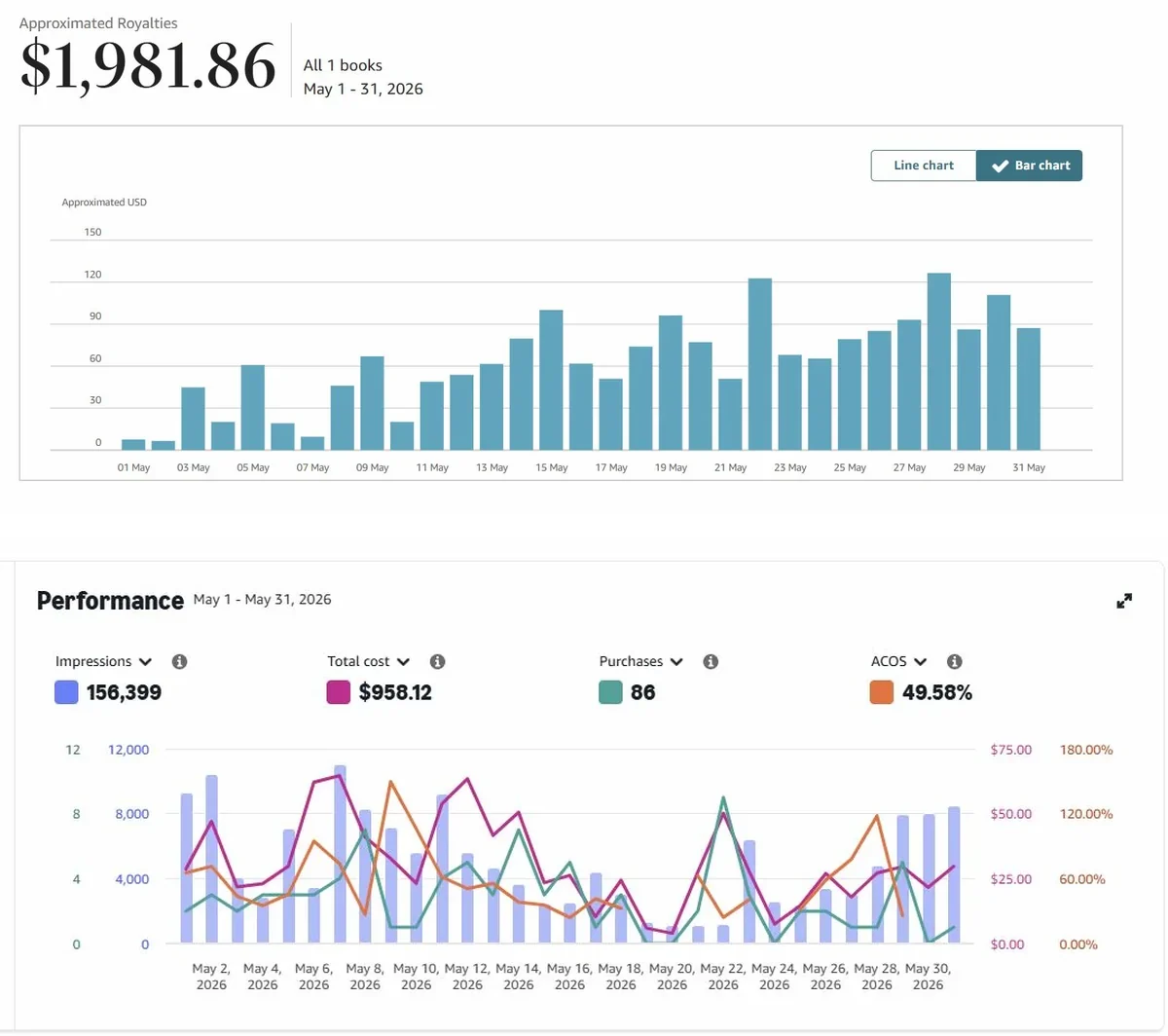 Tap to open full size
To make $1,000 a month net on Amazon KDP you need about $2,000 in royalties, which is 200-276 paperbacks a month, or 7-9 copies a day from one book. That's the level of a category bestseller, so it's a goal several months out, not month one. Below: the math worked backward, the six steps that lead to it, and what most often breaks the plan.
Work backward from $1,000
Most plans run forward: pick a niche, write a book, launch ads — and one day there will be money. Plan the other way: start from the number. If you don't yet know what the steps are, start with how to sell books on Amazon KDP and come back here for the math.
$1,000 net is not $1,000 in royalties. Ads are paid out of royalties, and they take a big share. Here is a real month from one of our books, May 2026 — the screenshots at the top of this page:
| May 2026 | |
|---|---|
| Royalties (KDP) | $1,981.86 |
| Ad spend (Amazon Ads) | $958.12 |
| Net | $1,023.74 |
So for $1,000 to stay with you, about $2,000 has to come in.
That's not an exception; it's the normal ratio. Our working range: ads take 30–50% of royalties, and 50–70% stays as profit. The low end is a well-tuned campaign; the high end is typical at launch, while campaigns are still collecting data.
What that means for a $1,000 net goal:
| Ads as a share of royalties | Royalties needed |
|---|---|
| 30% (tuned campaign) | ≈$1,430 |
| 40% | ≈$1,670 |
| 50% (typical at launch) | $2,000 |
So we plan with the honest number: $2,000 in royalties a month. If you do better than 50%, more is left — a pleasant surprise, not a missed plan.
The mistakes that leave a book unsold and an ad budget burned — on our own numbers and failures. Leave your email and we'll send it.
One email a week at most. Unsubscribe in one click.
How many copies a day that is
Next comes arithmetic worth doing before you pay for a book.
On Amazon.com, KDP pays 60% of the list price minus printing for paperbacks priced $9.99 and up (KDP Help). What's left depends on page count, ink and price. Our planning floor: at least $7.25 royalty per copy, ideally $10. That's not a wish but an input: page count and price are set from it. All the rates, with examples, are in KDP royalties explained.
| Royalty per copy | Copies a month for $2,000 | Per day |
|---|---|---|
| $7.25 | 276 | ≈9 |
| $8 | 250 | ≈8 |
| $10 | 200 | ≈7 |
Now the important part. Here is what a book that reached bestseller status in its category sells:

217 copies in 24 days — about nine a day. That's exactly what $2,000 in royalties takes at $7.25 a copy. In other words, "first $1,000 net a month" and "a bestseller in its category" are roughly the same level.
That's not a reason not to start. It's a reason not to plan $1,000 in the first month from a book made on a guess. Check your own book in the KDP royalty calculator, and you'll see how many copies you need to sell.
Step 1. A niche where $1,000 is possible at all
The niche matters more than the quality of the writing. A flawless book in an oversaturated topic sells worse than an average book where there's demand and few competitors.
In 2026 the winners aren't broad genres but precise sub-niches. A working formula for a topic:
audience + goal or pain + constraint + time frame or structure
For example: Prediabetes Meal Prep for Busy Women: 30-Day Plan, 30-Min Recipes, Low Added Sugar. All four parts are there, and a shopper knows instantly whether it's for them. A book called "Meal Prep Cookbook" competes with the whole market; a book built on the formula competes only with its sub-niche.
A quick check before anything is written: search the topic on Amazon, look at the top ten books from independent publishers in the organic results (not the Sponsored ones), and note their BSR (Best Sellers Rank: the lower the number, the better the book sells) and review counts. In our experience the niche is alive if competitors' BSR is under 40,000. BSR over 100,000 with 0–20 reviews — change the topic.
The full criteria and the signs of a fading niche: how to find a profitable KDP niche.
Step 2. Economics before publishing, not after
The step people skip most often — and the one that later costs the whole plan.
The order: price → margin → break-even ACOS → how much you can spend on ads. (ACOS is ad spend as a share of ad-attributed sales.)
- Price is set to fit the margin, not the other way round. For a standard 75-page paperback that's usually $22–25: at $24.99 in standard color on an 8.5×11 trim, the royalty is $10.98.
- Margin is what's left after printing. Our KDP royalty and break-even ACOS calculator shows it together with break-even ACOS.
- Break-even ACOS is the ceiling above which ads lose money. Every book has its own, and it depends on the margin: for the $24.99 book above it's 44%.
Without this math you can sell "at zero" for six months without knowing why: sales happen, royalties arrive, and nothing is left after ads. How break-even ACOS works and what to do when ads go over it: Amazon Ads for authors: judge by profit, not ACOS.
Step 3. The book and its packaging
You can write the book yourself or hire a writer. But "make a book" and "make a book people buy" are different jobs, and the second is almost entirely about packaging.
The market is flooded with low-effort AI content, so in 2026 quality doesn't mean "pretty"; it means "I trust this and I'll buy it." In practice that's four things:
- a cover that reads as a thumbnail next to competitors;
- a title that says what's inside and who it's for;
- a description written for a phone screen: short paragraphs, specifics, an answer to "who is it for / what's inside / what result";
- A+ Content that continues the cover.
Cover and A+ Content together cost about $200 — one of the smallest lines in the budget and, together with ads, one you shouldn't cut. What goes into the designer's brief: KDP book cover. How to build the book itself: how to create a book for KDP.
Step 4. First reviews
A book without reviews barely converts ad clicks: people land on the page and leave, because nothing on it shows that anyone has read the book.
Our launch target is around 30 reviews.
This is also the main trap of the whole plan: reviews are where beginners most often lose their accounts. KDP allows a free or discounted copy only if you don't require a review or try to influence it; per KDP Help, "Offering anything other than a free or discounted copy of the book, including gift cards, will invalidate a review." Reviews in exchange for compensation break Amazon's rules, and an account can be closed together with unpaid royalties. What's allowed and what isn't: how to get book reviews on Amazon.
Step 5. Three months of ads
Without ads a new book doesn't sell at all: it has no rank and no reviews, so Amazon has no reason to show it.
Budget about $3,500 for three months, and it isn't spread evenly: in our launches about $500 in month one, $1,000+ in month two, $2,000+ in month three. Spend grows with the campaign. Set the whole amount aside upfront: KDP pays royalties about 60 days after the end of the month of sale, so the first money arrives no earlier than month three, and until then campaigns are mostly collecting data. The full budget, line by line: how much it costs to self-publish on KDP.
Here's what trying to save on bids looks like:

157 impressions in three days, against tens of thousands a week for a working campaign. The budget really isn't being spent — but the plan isn't getting any closer either.
And the question that comes up right away: what if you start with minimal ads, $10–20 a day? People do — but then the goal is different: about $200 net a month, if everything goes right. Don't count on $1,000 from minimal ads; it's a different scenario, not the same road taken slower.
The rule works both ways: ads take 30–50% of royalties, so what you put into ads is roughly what stays as profit. For $1,000 net that's about $1,000 of ads a month, with royalties around $2,000. For $2,000 net it's about $2,000 of ads. These are our numbers in good months, not a forecast: in a weak niche the same budget can lose money.
Step 6. A weekly table
The most boring step, and the one without which you won't hold on to $1,000.
Once a week, record four numbers for each book and each marketplace:
- royalties in dollars;
- ad spend in dollars;
- profit — the difference;
- organic share — how many orders came without an ad.
The last one is the most telling. It's simple: organic orders divided by all orders. If the organic share grows, ads are building the book. If spend grows while organic falls, ads are eating the profit and building nothing — a signal to stop and investigate, not to add budget. What a healthy organic share looks like on our books: organic vs ad sales on KDP.
Look at the numbers every day, but give each book one decision at a time: scale, fix or stop. One decision, one action. After every change wait at least 7 days to collect data. Don't change everything at once, or in two weeks you won't know what worked.
What to look at in the reports, and in what order: why is my book not selling on Amazon.
You can keep the table by hand — KDP gives royalties, Amazon Ads gives spend, and you match them yourself (here's what the KDP dashboard does and doesn't show). We use AuthorLens, an analytics dashboard made only for Amazon KDP, which shows it ready-made: net profit per book and marketplace after ads, organic vs ad sales and TACoS (ad spend as a share of total sales), plus a Telegram report every morning.
We use AuthorLens daily and have a business relationship with it.
How long it really takes
The honest range is three months to a year.
Three months is the minimum for ads to collect data. Here's a book where things came together fast: for a year it made $700–1,500 a month; in May 2026 we took it on seriously — and it made $3,309 in royalties that month against $1,400 in April, 2.4 times more. Not a page of the book changed, only the ads.
And here's the other timeline:

Nine months near zero. The niche was fine and ads were running. Over that time the cover was changed about ten times, the listing rewritten, the A+ Content redone — one change at a time. In the tenth month the book took off.
Both timelines are normal. What isn't normal is stopping in month four because the budget ran out before the data came in.
What most often breaks the plan
Four reasons, and none of them is bad luck.
The budget covers the book, not the ads. Someone counts the text and the cover, gets $1,200 — and doesn't set aside three months of ads. Two months in, the money runs out exactly when the campaigns start producing data.
The niche was chosen because the topic is interesting. No cover or ad fixes that: ads only show a weak product to more people, faster. A special case is coloring books: the easiest-looking entry, which in most cases ends $1,000–2,000 in the red.
The economics weren't done before publishing. The price is lower than what ads can carry, and the book sells at zero for years.
Everything changes at once. New cover, rewritten description, new keywords and new bids in one day — and the cause of the result is lost for good.
More typical mistakes, each with its price: KDP mistakes beginners make.
The plan in seven lines
- Work backward: $1,000 net ≈ $2,000 royalties ≈ 200–276 copies a month ≈ 7–9 a day.
- Pick a sub-niche with the formula "audience + pain + constraint + time frame" and check it by BSR.
- Work out price, margin and break-even ACOS before paying for the book.
- Invest in the cover and A+ Content — about $200 of the whole budget.
- Get the first reviews within Amazon's rules.
- Fund ads for three months upfront, and don't cut bids "to save money."
- Once a week: four numbers and one decision for each book.
The shortest takeaway: the first $1,000 isn't about luck. It's about whether steps one and two were done before the money was spent.
FAQ
How many books do I need to sell to make $1,000 a month on KDP?
About 200-276 paperbacks a month, depending on how much royalty is left per copy after printing. That's 7-9 copies a day, because ads usually take 30-50% of royalties and $1,000 net needs about $2,000 in royalties.
How long does it take to make $1,000 on KDP?
Plan ads for at least three months, the minimum for campaigns to collect data. It can take longer: one of our books sat near zero for nine months and took off in the tenth, while another went from $1,400 to $3,309 in royalties in one month after we reworked its ads.
How many books do you need to make $1,000 a month on Amazon?
One book can do it if the niche and ads come together. It's safer to plan on two or three, because income across books is very uneven: on most accounts one or two titles bring in most of the money.
How much money do I need to start making money on KDP?
In our experience a first book needs $3,700-$4,700. The biggest cost isn't the book but three months of ads paid upfront, because KDP pays royalties about 60 days after the end of the month of sale.
Can you make money on KDP without ads?
Not at launch. A new book has no rank and no reviews, so Amazon has no reason to show it. Organic sales come later, as a result of sales, not instead of them.
Royalties and ad spend per book, side by side — the way we track our own books. It also shows the highest ACOS each book can afford. Leave your email and we'll send it.
One email a week at most. Unsubscribe in one click.
Real campaign numbers, not theory. One recent case: the same keyword in two match types — broad at 9% ACOS, exact at 49%. In the Facebook group KDP Ads & Profit we break down cases like this every week.
Join the group →or follow Darya on LinkedIn

Selling books on Amazon KDP since 2023, 77,600+ copies sold. Every number in these articles comes from our own KDP and Amazon Ads accounts.
All articles