Amazon Ads
How to get book reviews on Amazon without risking your account
To get book reviews on Amazon safely, sell to real readers and ask for honest reviews. KDP allows exactly one thing in return for a review: a free or discounted copy, with no review required. Below: how many reviews a book needs, what Amazon treats as a violation, where first reviews come from and what to do with a one-star review.
Why reviews matter more than they seem
A review on Amazon isn't decoration; it's the answer to a doubt. A shopper has already clicked on the book, read the description and stopped at the Buy button: is it really what it promises? Reviews are the only thing on the page not written by the seller.
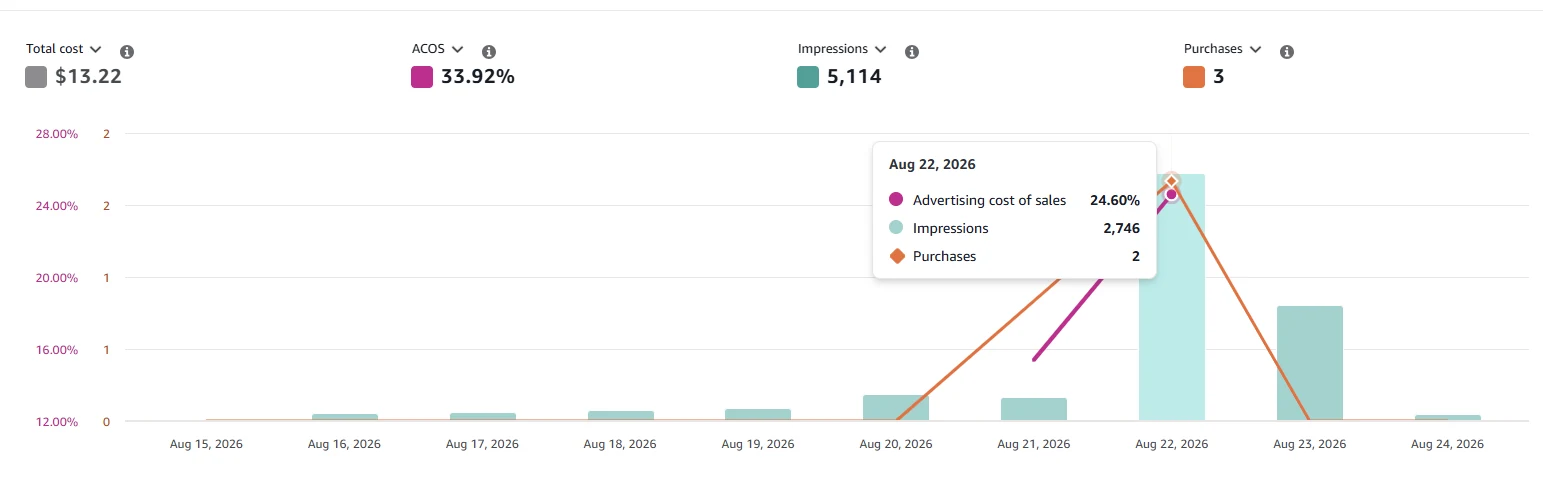
You can see the effect in ads. The screenshot at the top of this page is a campaign for a book with no reviews yet: ten days, 5,114 impressions, three sales, $13.22 spent. The ads run, but people reach the page, find no reviews and leave.
So reviews aren't something to deal with "later, once sales pick up". They're the condition for ads to pay off at all.
How many reviews a book needs, what Amazon forbids and where to get first reviews without risking your account. Leave your email and we'll send it.
One email a week at most. Unsubscribe in one click.
How many reviews a book needs
Our working target is around 30 reviews in the first two or three months, and 30–50 over the whole ramp-up period, counting star-only ratings.
First, two terms that get mixed up:
- A review is text. People read it.
- A rating is stars only, with no text. It affects the average score but explains nothing to a shopper.
You need both, but written reviews matter more. It also helps when a few of them are more than text: two or three reviews with photos of the book and a couple of videos show a shopper what no description can — what the book looks like in someone's hands.

Here's how a 4.5 rating adds up for a big-publisher book with twenty-two thousand ratings: 72% five stars, 16% four stars and 12% everything else. Look at the bottom rows: there are twos and ones even here, and that's normal. A page with nothing but five-star reviews is exactly what makes a shopper suspicious.
Note Amazon's own wording, too: global ratings. That number includes both people who wrote a review and people who only left stars. And the star average isn't a simple average: according to KDP Help, "Amazon calculates a product's star rating using machine-learned models instead of a simple average."
One more thing people don't think about at launch: proportion. In our experience, real buyers leave roughly one review per ten sales, often fewer. That's not an Amazon rule, just what we see on our own books — but it's the benchmark for whether a book's review count looks natural.
What Amazon treats as a violation
This is the most important part of the article, because getting it wrong costs more than everything else combined. Amazon's rules come from two places: KDP Help on customer reviews and Amazon's page on how it keeps reviews trustworthy (both checked September 2026). Here's what they rule out.
1. Reviews for compensation. KDP is explicit: you may give readers free or discounted copies of your book, but "Offering anything other than a free or discounted copy of the book, including gift cards, will invalidate a review", and Amazon removes it. Money, refunds, gift cards, "I'll reimburse your purchase", a thank-you bonus — it doesn't matter who pays or what it's called.
2. Requiring or steering a review. Even the free copy is allowed only "as long as you do not require a review in exchange or attempt to influence the review." So: no "please leave five stars", no "only review it if you liked it", no "delete the bad review and I'll refund you".
3. Review swaps. Amazon lists a review given in exchange for a positive review from a peer as a violation. "I review yours, you review mine" between authors is exactly that.
4. Scripted reviews. "Here's the text", "please include these keywords", "I'll write it, you just post it". Handing someone the words is the most direct way to influence a review, whether or not the review is true.
5. Family, friends and people close to you. Amazon lists "A review by someone perceived to have a close personal relationship with the product's owner, author, or artist" among prohibited reviews. Note the word perceived: it's Amazon who decides, not you.
6. Reviewing your own book. Also on Amazon's list: a review by the product's maker posing as an unbiased shopper, or by anyone with a financial interest in the product. Buying your own book to review it is the crudest version of this.
7. A sudden wave of reviews right after launch. This one isn't a written rule, it's our caution. The danger isn't the number but the pace: fifteen reviews in three days on a brand-new book look exactly like what they usually are.
What Amazon can do about it, per the same trust page: remove reviews, revoke review privileges, withhold payments, block accounts and take legal action. For KDP authors that means the account, not just the book — see why KDP accounts get terminated.
The general rule: if you can describe what you did as "we organized reviews", it's risky.
Amazon is stricter than US law here. The FTC's (Federal Trade Commission) Consumer Reviews and Testimonials Rule, in effect since October 21, 2024, bans incentives tied to a particular sentiment and fake reviews, and courts can impose civil penalties. The FTC does allow some incentives for honest reviews. Amazon doesn't: on Amazon, the only thing you may give a reader is the book itself.
Where the first reviews come from
There are few safe sources, and none of them is fast.
Organic buyers. The best and safest source: ads run, sales come in, and some buyers write a review on their own. The honest answer to "how many" is: very few. But these reviews carry zero risk. How organic sales grow once ads are running: organic vs ad sales on KDP.
Your own audience. Social media, your email list, readers who already know you. You can say: "The book is out. If you read it, I'd be grateful for an honest review." You can't say: "Buy it and I'll refund you" or "Review it and get a bonus". The difference between those two sentences is the difference between normal promotion and a violation.
A line at the end of the book. A short, polite request on the last page — "if this book helped you, an honest review helps other readers find it" — reaches exactly the people who finished it. No rating asked for, nothing offered.
Advance reader copies (ARCs). Giving free copies to readers before or at launch is the one form of "giving something" KDP explicitly allows — as long as the review isn't required and you don't try to influence it. More on that below.
What isn't on this list: organized purchases, "our own" buyers, commissioned review texts, review exchange groups. That's not an oversight — those are exactly the things from the previous section.
Advance reader copies: what to expect
ARC readers get the book free, read it, and may leave a review. You can find them through your own list and reader communities in your genre, or through ARC services that distribute free copies to readers who've signed up for them.
What to understand before you start:
- No guarantee of five stars. A reader writes what they think. That's both the upside and the downside.
- The pace is moderate. From one source, expect something like ten reviews a month, not thirty in a week.
- Reviews don't appear instantly. Amazon posts a review only after its Community team checks it, and KDP says "These checks can take a few days."
- The review must stay optional and unscripted. The moment you add "please give five stars" or "write it like this", you're back in the previous section.
- Avoid anything that sells reviews rather than copies. If a service promises a number of reviews, a minimum rating, or asks you to review other authors' books in return, walk away.
A middleman doesn't make a practice acceptable. Amazon's rule is the same whoever sits in between: a review in exchange for anything beyond the book is not allowed.
Which reviews actually carry weight
Not all reviews are equally useful, and it's not about the stars.
"Great book, thanks" is five stars and zero information. It lifts the average and does nothing else: a shopper who had doubts still has them.
What works is different. A review carries weight when it shows three things:
- how the reader used the book — every day, following the plan, picking and choosing;
- what exactly helped — a specific part, section or approach;
- who the book is for — a beginner, a busy person, someone who's tried before.

Here are those three things in a real example. The first review does the job: the reader says they cooked from the recipes, which ingredients were hard to find, and what their kids liked. It removes doubt. The second — "great recipes, as always" — is five stars and nothing for someone deciding.
Both carry the Verified Purchase badge. Amazon uses it to mark reviews from people who bought the book on Amazon. Shoppers look for it — which is one more reason faking reviews is pointless.
That's shopper logic, not an Amazon rule: people read reviews to settle their own doubts before buying. Three sincere, specific reviews do more for conversion than twenty empty ones.
It also explains why you should never hand a reviewer a ready-made text: a review written by the seller always sounds like a product description, not a reader's experience. Shoppers notice, and so does Amazon.
What to do about a negative review
First, read it as a to-do list.
Very often one star isn't about the content but the production: small print, poor print quality, too few examples, the wrong paper. Those can be fixed, and fixed cheaply, because you can upload a new manuscript file.
If a review clearly breaks Amazon's rules — it's not about the book but abuse, spam or a complaint about delivery — you can report it with the Report link under the review. Amazon's Community team investigates, and per KDP Help "For privacy reasons, this team won't share the outcome of their investigation."

Use it only in obvious cases. Reporting every critical review won't get honest criticism removed, and it isn't what the button is for.
What never to do: message the reviewer asking them to take the review down, let alone offer something in return. That's point 2 on the list above.
And separately: one negative review at the top of the page can wipe out your conversion. So what matters isn't "removing" it but getting enough other reviews that it stops being the only one.
One practical note from KDP: if you update your book, existing reviews about the old version aren't removed automatically unless they break the guidelines. Fixing the file stops new complaints; it doesn't erase old ones.
How to tell it's really the reviews
Reviews don't explain everything. Before you put effort into them, check which step of the funnel is broken.
- Few or no impressions — reviews aren't the problem. Look at keywords and bids.
- Impressions, but no clicks — not reviews either. In search results a shopper sees only the cover, the title and the price.
- Clicks, but no sales — this is where reviews become a prime suspect, along with the description and A+ Content.
The full breakdown with numbers is in why is my book not selling on Amazon. And before you advertise a book with no reviews, check whether it can afford the ads at all: KDP royalty and break-even ACOS calculator (ACOS is ad spend as a share of ad-attributed sales).
The short version
Allowed: run ads and wait for organic reviews; ask your own audience for an honest review with nothing offered in return; give free or discounted copies without requiring a review; add a polite request at the end of the book; fix the book based on what negative reviews say.
Not allowed: pay for a review in any form, including gift cards and refunds; require a review or ask for a specific rating; supply the text; swap reviews with other authors; get reviews from family and close friends; review your own book.
The difference between the two lists isn't the result. It's whether you still have an account six months from now.
FAQ
How many reviews does a book need on Amazon?
Our working target is around 30 in the first two or three months and 30 to 50 over the ramp-up period, counting star-only ratings. It isn't a magic number; it's the point where the page stops looking empty to a shopper.
Can I pay for Amazon book reviews?
No. KDP Help says offering anything other than a free or discounted copy of the book, including gift cards, invalidates a review, and Amazon removes it. Amazon can also restrict or block the accounts involved.
Can I give free copies of my book in exchange for reviews?
You can give free or discounted copies, but KDP only allows it as long as you don't require a review in exchange or try to influence it. The reader decides whether to review and what to write.
Can family and friends review my book on Amazon?
Amazon lists reviews by someone perceived to have a close personal relationship with the author among prohibited reviews. Such reviews can be removed, so don't build your launch on them.
How do I remove a bad review on Amazon?
You can't remove a review just because it's negative. If it breaks Amazon's rules, for example spam, abuse or a delivery complaint, use the Report link under it. Otherwise, fix what it points out and focus on getting more honest reviews.
Royalties and ad spend per book, side by side — the way we track our own books. It also shows the highest ACOS each book can afford. Leave your email and we'll send it.
One email a week at most. Unsubscribe in one click.
Real campaign numbers, not theory. One recent case: the same keyword in two match types — broad at 9% ACOS, exact at 49%. In the Facebook group KDP Ads & Profit we break down cases like this every week.
Join the group →or follow Darya on LinkedIn

Selling books on Amazon KDP since 2023, 77,600+ copies sold. Every number in these articles comes from our own KDP and Amazon Ads accounts.
All articles