Niche & book
Are coloring books profitable on KDP? Not for a newcomer
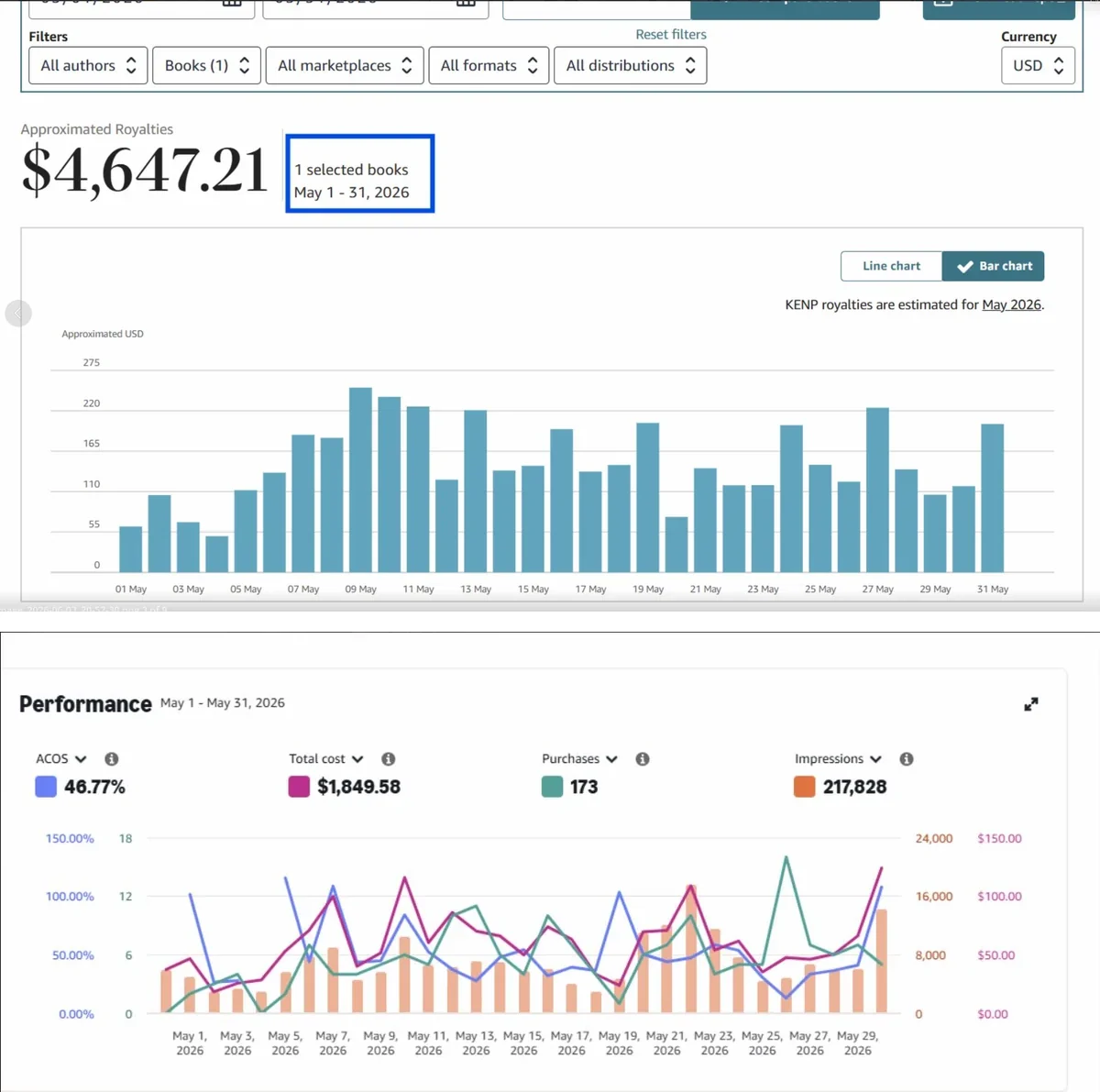 Tap to open full size
For a newcomer, coloring books and word searches on KDP are almost never profitable: the best case earns $3.15 a copy in the US, and a sale through Amazon Ads costs $4.80 to $6.40. They look like the easiest way into the book business, which is exactly why they end in a $1,000 to $2,000 loss in most cases. Here is the math from the KDP calculator and what to do instead.
Why everyone starts with coloring books
The beginner's logic makes sense: you don't have to write a coloring book. No text, no ghostwriter, no editing. The interior comes together in an evening, and the cost looks close to zero.
That's exactly why these niches are crowded. An easy entry means everyone who was looking for an easy entry got there years before you. It's the classic niche research mistake: picking a topic because it's easy to produce, not because of demand and margin.
And the result is usually the same: in the vast majority of cases, a loss of $1,000–2,000 — and that's precisely the money spent on ads that never paid off.
Here's the trap. People make the interior themselves and often draw the cover themselves too, so getting in costs nothing. That's why it looks easy. What you end up paying for is the one thing you can't do by hand: getting the book seen. The ads run, the clicks get charged, the sales don't cover them — and the loss piles up there, not in production.
Below are the reasons it works out this way. The first two are arithmetic, and nothing can be done about them. The other five just stack on top.
The mistakes that leave a book unsold and an ad budget burned — on our own numbers and failures. Leave your email and we'll send it.
One email a week at most. Unsubscribe in one click.
1. The margin is tiny
The main reason, and it's pure math.
Coloring books sell for $7.99–9.99: kids' books cheaper, adult books with 100–120 pages a bit more. They're printed in black ink — the buyer does the coloring, so color printing isn't needed.
What you keep per copy
Take the best case. An 8.5 × 11 in coloring book, 108 pages, black ink, priced at $9.99 — right at the threshold where Amazon pays 60%. On Amazon.com, KDP pays 60% of list price minus printing for paperbacks at $9.99 and up, and 50% at $9.98 and below (KDP Help, paperback royalty). Printing for this book is $2.84, so the royalty is $3.15 per copy:
$9.99 × 60% − $2.84 = $3.15
Now look at the other marketplaces. If you let KDP convert the price automatically, in our calculator it came out at €8.56 in Europe — below the €9.99 threshold. The rate there drops to 50%, not 60%, and the royalty is €1.80; in the UK it's £1.51 (the UK threshold for 60% is £7.99, and the converted price lands under it).
Elsewhere it's €1.80 or £1.51, and in some marketplaces less, so we plan with a conservative $1.75 a copy. And that's the best case, with every parameter tuned.

The 108 pages aren't random, either. On Amazon.com, a black-ink paperback in a large trim (wider than 6.12 in or taller than 9 in) costs a flat $2.84 to print from 24 to 108 pages, and from 110 pages on it's $1.00 plus $0.017 per page (KDP Help, printing costs). So a 60-page book costs exactly as much to print as a 108-page one.
For comparison: a regular 75-page book at $24.99 in the same 8.5 × 11 in size, printed in standard color, costs $4.02 to print and earns about $10.98 — more in KDP royalties explained.
Why you can't just raise the price
The obvious fix: if the margin is small, charge $16.99 instead of $9.99 and triple the royalty. On paper, yes. In practice, no.
Buyers see a coloring book as a low-value product. They don't expect anything exclusive: coloring pages look the same in any book, and they won't pay much above the market. Many just grab free printable pages and print them at home.
The market range is $7.99–9.99, and stepping outside it means dropping out of the results: right next to you are hundreds of books that look the same and cost half as much.
And there's a second trap in the same spot: you can't go lower either. Below $9.99, Amazon pays 50% on a US paperback instead of 60% — so competing on price also takes ten percentage points off your royalty.
2. Ads don't pay off
Let's count. In our accounts, a click on Amazon Ads costs around $0.80. At 6–8 clicks per sale, one buyer costs $4.80–6.40.
Now put that next to the royalty. Even in the best case — $3.15 in the US — every ad-driven sale loses one and a half to three dollars. In Europe, with a royalty of €1.80, the loss is bigger than the whole margin.
This isn't "ads barely pay off." Ads on a coloring book don't pay off at all: bids in the category are high, and the margin has nothing to pay them with. For a $9.99 coloring book with a $3.15 royalty, break-even ACOS (the ad spend to ad sales ratio above which ads lose money) is about 32%. How to see break-even ACOS for your own price is in Amazon Ads for authors: profit, not ACOS.
Coloring book vs. a regular book
The same numbers side by side:
| Coloring book | Regular book | |
|---|---|---|
| List price | $9.99 | $24.99 |
| Printing cost | $2.84 | $4.02 |
| Royalty per copy | $3.15 | $10.98 |
| Ad cost per sale | $4.80–6.40 | $4.80–6.40 |
| Result of one ad sale | −$1.65 to −$3.25 | +$4.58 to +$6.18 |
The cost of winning a buyer is the same — Amazon doesn't give cheap books a discount on clicks. The only difference is what's left after it.
Five more reasons that stack on top
None of these is fatal on its own. But they sit on top of a $1.75 margin, and together they close the niche to a newcomer.
Heavy competition. Since adult coloring books took off, the market has filled with thousands of titles, and new ones appear every day. Standing out is nearly impossible: the popular keywords and categories are packed, and a new book lands on page ten, where nobody sees it.
Limited SEO (search optimization). Coloring books and word searches have generic titles and descriptions: "coloring book for adults," "word search puzzles for seniors." It's hard to come up with something unique, because buyers search with exactly those words. So the whole niche fights for the same high-volume searches, with no narrower query to hold on to. A regular book can come in through a specific topic; here you can't. How keywords work for regular books is in Amazon KDP keywords.
Piracy and free content. Coloring pages are easy to copy: many people download them from pirate sites or use free generators. That undercuts demand for paid books. In a niche where the margin is already $1.75, any drop in demand is critical.
A one-time product. A coloring book gets used once: color it in and you're done. A regular book gets reread, recommended, given as a gift; a coloring book doesn't have that life. To keep income going you have to keep releasing new ones — and each one needs time, design and its own ad budget.
A narrow audience. The main buyers are kids, parents, and people looking for a way to relax. They're not the most active buyers in the book market: they buy rarely and cheaply. Nonfiction readers in health or finance buy more regularly and pay more for a useful result.
"But some people do make money on them"
They do. Look at who.
They're sellers who entered these niches in 2018 or earlier. They have hundreds of reviews, stable organic rankings, and sales that come without an ad budget. Their margin is the same $1.75, but they don't pay to win buyers.
They used strategies that aren't available to a newcomer today: competition has grown, and Amazon's algorithms have changed.
So the stories about making money on coloring books are true — just not for someone starting today.
It's like an apartment bought twenty years ago versus one bought now: both earn rent, but the entry price is different. The 2018 seller gets their $1.75 per copy with no ad spend, because the book sits in organic results. A newcomer pays $4.80–6.40 for every sale, and loses on each one.
The question isn't whether you can make money on coloring books in principle. It's whether you can do it today, from zero — and there the answer is no. What starting from zero looks like in other niches is in how much KDP authors make.
If your coloring book is already published
Some readers get here after the book is out and the money is spent. What to do:
Check the price. Below $9.99 on Amazon.com you get 50% instead of 60%. Raising it to $9.99 is the fastest way to increase royalty, and sales often barely drop.
Turn off the ads. With a $3.15 royalty and $4.80–6.40 per buyer, every ad sale deepens the loss. Without ads, the book at least stops losing money.
Let it sit. A published book costs you nothing: KDP doesn't charge for keeping it live, and it's printed only when someone orders it. Any organic sales are pure profit. How big an organic share a book can hold without ads: organic vs ad sales on KDP.
Don't make another one just like it. The most expensive mistake is deciding that one particular book failed and making five more. It's the niche's economics that failed, and they're the same for every book in it.
What to do instead
Look at niches with real text and a normal price: health, nutrition, self-help, finance, narrow practical topics.
There, a book sells for $20–25, the royalty is around $10–11, and ads pay off: spend $5 to win a buyer and you're still in profit. That difference decides whether a book is a business or a hobby.
You can check the economics of a future book in our KDP royalty and break-even ACOS calculator in two minutes, before you order anything.
Yes, you'll have to deal with text. But that cost pays for itself — unlike an evening spent on a coloring book interior that won't sell. How to plan that text is in how to create a book for KDP.
To check a specific topic on live data, we use AuthorLens, an analytics dashboard made only for Amazon KDP.
We use AuthorLens daily and have a business relationship with it.
Its competitor, niche and category screens (Books, Compare, Discover, Opportunities) let you compare the books and categories you're considering before you commit a budget to one of them.
FAQ
How much does a coloring book make on KDP?
In the best case, an 8.5 x 11 in, 108-page black-ink coloring book at $9.99 costs $2.84 to print and earns $3.15 per copy on Amazon.com. With automatic price conversion it earned about 1.80 euros in Europe and 1.51 pounds in the UK in our calculation, because the converted prices fall below the 60% threshold.
Why don't Amazon Ads work for coloring books?
In our accounts a click costs around $0.80 and it takes 6 to 8 clicks to make a sale, so one buyer costs $4.80 to $6.40. That is more than the $3.15 royalty, so every ad-driven sale loses money.
What is the best price for a coloring book on KDP?
On Amazon.com, $9.99. At $9.99 and above a paperback earns 60% of list price minus printing; at $9.98 and below it earns 50%. The market range is $7.99 to $9.99, so there is little room to go higher.
Why do some sellers still make money on coloring books?
Most of them entered around 2018 or earlier. They have hundreds of reviews and steady organic sales, so they earn the same small margin without paying for ads. A new book has to buy its visibility, and the margin can't cover it.
What should I do if my coloring book is already published?
Set the US price to at least $9.99 to get the 60% rate, turn off ads that lose money on every sale, leave the book live for organic sales, and don't publish more books with the same economics.
Royalties and ad spend per book, side by side — the way we track our own books. It also shows the highest ACOS each book can afford. Leave your email and we'll send it.
One email a week at most. Unsubscribe in one click.
Real campaign numbers, not theory. One recent case: the same keyword in two match types — broad at 9% ACOS, exact at 49%. In the Facebook group KDP Ads & Profit we break down cases like this every week.
Join the group →or follow Darya on LinkedIn

Selling books on Amazon KDP since 2023, 77,600+ copies sold. Every number in these articles comes from our own KDP and Amazon Ads accounts.
All articles