Getting started
Amazon KDP pros and cons: is it worth it?
 Tap to open full size
Amazon KDP is worth it if you treat a book as a product with a budget for ads and can wait months for profit; it's not worth it if you want passive income with no money in. Below are the four real advantages that bring people to KDP and the five downsides that make them quit, all with numbers from our own accounts rather than promises.
What this business really is
Amazon KDP lets anyone publish a book without a publisher. You upload a file and a cover and set a price. Amazon lists the book, takes the order, prints the paperback after it's bought and ships it to the reader. You get a royalty on every sale.
That sounds risk-free. It isn't. The risk just sits somewhere else: not in printing or inventory, but in ad money and in the time before the first profit.
Below, in order: first what people come to KDP for, then what makes them quit. If you're new to the platform, start with what Amazon KDP is and how it works.
The short version, on one screen:
| Pro | The con that comes with it |
|---|---|
| No print run, no inventory, printing after the order | You still need money, for ads instead of printing |
| Amazon handles selling, printing and shipping | Amazon also makes the rules, and can close your account |
| Income isn't tied to your hours | It doesn't arrive on schedule either; sometimes it takes a year |
| You can keep improving the book | Some fields, like the title, lock after publishing |
| A good book keeps earning for years | Only while someone keeps running its ads and listing |
The mistakes that leave a book unsold and an ad budget burned — on our own numbers and failures. Leave your email and we'll send it.
One email a week at most. Unsubscribe in one click.
Pro 1. No print run, no warehouse, no money tied up
A traditional print run means paying first: a thousand copies are printed and now they sit there. Sold or not, the money is spent, and storage costs extra.
KDP has none of that. Each copy is printed after it's ordered, and the printing cost comes out of that same sale. A book nobody buys costs you nothing.
Publishing and staying listed are free too. No monthly fee, no charge for updating the file: you can re-upload the cover or the interior as many times as you like.
The practical effect people underrate: a book that flops doesn't lock your money up forever. It takes what you spent on writing, design and ads, but leaves no unsold stock behind. That's a very different cost of failure from selling physical products.
Pro 2. Amazon does everything except the book
Printing, packing, shipping, returns, payments, customer service: all Amazon. You don't need a warehouse, a courier, a payment processor or a company to start.
The biggest part is access to buyers. Amazon shows your book to people who are already searching for your topic. No website to build, no traffic to buy from scratch, no stranger to persuade to type in a card number: the buyer came to shop, in a store they already trust.
It works from anywhere. KDP says you can "self-publish your book in more than 10 countries in over 45 languages" (KDP); authors outside the US can read Amazon KDP for non-US authors.
One book can go out in three formats, Kindle, paperback and hardcover, each from its own file, all on one product page. On our accounts, about 90% of sales are paperbacks.
Pro 3. Income isn't tied to your hours
This is the main difference from any service business. The book sells the same whether you work today or not.

One book, one month, $1,023 net. It scales not by hiring people but by adding books: each new one adds to the ones already selling.
Just don't confuse this with passive income. One author we know, who grew her account to $3,000 a month net, spent about an hour a day on it: ads, numbers, listing fixes. Not much, but not zero, and it never goes away.
Royalties aren't magic numbers either. KDP pays 35% or 70% of the price for an eBook; since July 7, 2026, the 70% rate covers list prices from $2.99 to $12.99 on Amazon.com (KDP Help). For a paperback it's 60% of the list price at $9.99 and above on Amazon.com, 50% below that, minus printing (KDP Help). Printing depends on page count and ink. So a cheaper book isn't always better: work out what you keep after printing before you set the price.
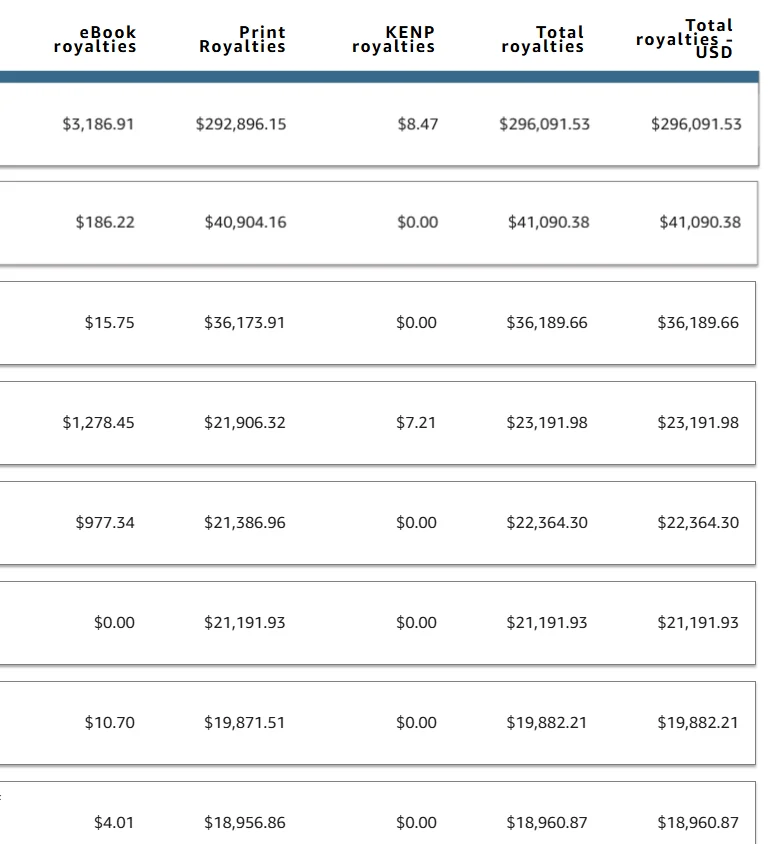
And income is uneven. Look at the screenshot at the top of this page: on that account the best book earned $296,091.53, and the next one $41,090.38. That's normal in this business: one or two books carry the account, the rest just exist.
Pro 4. A good book keeps earning for years
A book isn't a one-season product. Once it has reviews, rankings and working ads, it keeps selling month after month, and each new book adds to the ones already on sale.
We have books published two years ago that still sell. The condition is the same as everywhere in this business: someone keeps an eye on the ads, the numbers and the listing.
Con 1. The big money isn't the book, it's the ads
This is where most beginners disappear.
A realistic first-book budget in 2026 is $3,700 to $4,700. Writing $0–1,000, cover and A+ Content around $200. And ads, which grow with the campaign: about $500 the first month, $1,000+ the second, $2,000+ the third, around $3,500 for three months.
Three months of ad money isn't overcaution. KDP pays about 60 days after the end of the month of the sale (KDP Help), and without ads nobody sees a new book: it has no ranking and no reviews. Organic sales come later; how big their share gets on our books: organic vs ad sales on KDP.
Here's what trying to save on ads looks like:

Bids of $0.21–0.51, the budget barely spent, and the book was seen 157 times in three days. A working campaign gets tens of thousands of impressions a week.
What you keep depends on what you put into ads, because ads take 30–50% of royalties on our accounts. For example, $1,000 a month in ads brings about $2,000 in royalties: half goes back to ads, about $1,000 is net. Getting to about $2,000 net took about $2,000 a month in ads. These are our numbers in good months, not a forecast: in a weak niche the same budget can lose money. You can start with $10–20 a day, but then expect something else: few sales, about $200 a month net, if things go well.
So the honest answer to "can I start with nothing" is no. The budget line by line is in how much it costs to self-publish on KDP, and why ACOS (ad spend as a share of ad-attributed sales) alone misleads you is in Amazon Ads for authors: profit, not ACOS.
To see how much of the ad money came back and what was left, we use AuthorLens, an analytics dashboard made only for Amazon KDP. We use AuthorLens daily and have a business relationship with it. It shows royalties, ad spend and net profit per book and marketplace in one view.
Con 2. Some mistakes can't be undone
KDP Help lists the details you can't change after publishing. For paperbacks and hardcovers they include the language, title, subtitle, edition number, primary author, trim size and a few more; for eBooks, the language, title, subtitle, edition number and primary author (KDP Help).

There is one short rescue window. For print books, you "can edit your book's title, subtitle, or primary author name within 72 hours of your title's initial publication date, after it is no longer In Review." After that, "these fields are fully locked" and the only route is a new edition. A pure typo in a title or author name can still be fixed by KDP Support (KDP Help). Anything more means a new edition, which starts without your reviews, category rankings or ad history.
The cover, price, description, keywords and categories can be changed as often as you like. The problem is that beginners learn which is which after they publish. The fields worth checking three times are in what you can't change after publishing.
Con 3. Your account can be closed
Amazon closes accounts for breaking its rules. It's neither rare nor a myth.

That one email carries two pieces of news: every book comes off sale, and royalties not yet paid won't be. The KDP Terms say the same: if Amazon terminates the agreement because you breached your warranties or the Content Guidelines, "you forfeit all Royalties not yet paid to you" (KDP Terms and Conditions).
The reasons are often careless, not criminal: copyrighted or trademarked material in the text or on the cover, the same book under different titles, manipulated reviews, a second account. Amazon doesn't negotiate. It sends an email.
Understand the scale. It's not one book that goes, it's the whole account: every book, all ad history, all the reviews and rankings built over months. And you can't simply open a new one. Amazon's policy "prevents creating a second account" (KDP Help), and after termination the Terms say "you will not establish a new account." In our experience, accounts get linked through payment details and tax information, even when the new one is in someone else's name.
The only protection is reading the rules before you publish. The nine reasons this actually happens are in KDP account terminated: why and what to do.
Con 4. Niches don't last forever
A book takes two or three months to make. The niche can change in that time, and you won't see it until you turn on ads.

We had two books on one topic on different accounts, and both made $2,000+ a month net. The logic seemed obvious: the topic works, make a third. The third earned $15,728 in royalties in a year, but ads ate $9,991 at a 50.17% ACOS. Net was about $480 a month instead of $2,000.
The book sells. Almost 1.8 million impressions, orders keep coming. Each buyer simply costs twice as much as a year ago, because the niche got crowded.
No cover or ad tweak fixes that; only the next book on a different topic does. That's why we check a niche before the first line is written, with numbers, not gut feel.
Coloring books are a special case of the same mistake. They look like the easiest way in and, in most cases we've seen, end $1,000–2,000 in the red.
Con 5. "Three months" can turn into a year
Three months of ads is the minimum, not a promise.

For nine months the chart sat near zero. The niche was fine and ads were running. In that time the cover changed about ten times, the listing was rewritten, the A+ Content redone, one change at a time, so we could tell what worked.
In May 2026 the book took off and reached bestseller status in its category: 217 copies in the first 24 days of August.
A happy ending, but it was nine months of work with no result. Not everyone can sit through that, and it's fair to know it in advance. How to find what's actually broken instead of changing everything at once is in why is my book not selling on Amazon.
So, is Amazon KDP worth it?
Short and without softening.
It's worth it if you:
- have the full $3,700–4,700, not "I'll start with $300 and add more later";
- can go a year without profit and not quit in month four;
- make decisions from numbers, not feelings;
- want a dollar-earning asset that keeps selling for years.
It's not worth it if you:
- want passive income with no involvement; there isn't any here;
- need fast money: for the first three months you only spend;
- won't read Amazon's rules; losing an account costs more than an hour of reading;
- are investing your last savings. This is a business with risk, not a savings account.
The most common mistake at the start is budgeting for the book and not for the ads. The second is picking a niche at random because "the topic is interesting." Both cost months and don't show up right away. The rest are in 10 KDP mistakes beginners make, with the price of each.
FAQ
Is Amazon KDP legit or a scam?
KDP itself is Amazon's own self-publishing service. It promises nothing and takes its share from each sale. The scams are the promises around it: passive income with no investment, $10,000 in a month, upload books and wait. Reality is a budget from about $3,700, three months of ads paid up front, and three months to a year before results.
Is Amazon KDP still worth it in 2026?
Yes, but it's not the easy entry it was a few years ago. Few empty niches are left and a new book barely sells without ads. The people earning are the ones who run the numbers and invest in quality, not the ones uploading lots of simple books. KDP also now limits new titles to 2 per format per week.
Is KDP passive income?
No. It's a business with delayed returns: ads need managing, numbers need checking, listings need fixing. One author we know who reached $3,000 a month net spent about an hour a day on it.
How much money do you need to start on KDP?
In our experience a realistic first-book budget in 2026 is $3,700 to $4,700. The biggest item is ads, not the book: budget three months ahead, because KDP pays about 60 days after the end of the month of the sale.
Can you lose money on Amazon KDP?
Yes. The most common case we see is losing $1,000 to $2,000 on coloring books or on a niche picked at random. The money goes slowly: ads run, sales are few, and it feels wasteful to stop.
Can Amazon close my KDP account?
Yes. KDP can terminate or suspend an account if it has concerns or finds a breach. If it terminates for a breach of its warranties or Content Guidelines, unpaid royalties are forfeited and you may not open a new account. Read the rules before publishing, not after.
Royalties and ad spend per book, side by side — the way we track our own books. It also shows the highest ACOS each book can afford. Leave your email and we'll send it.
One email a week at most. Unsubscribe in one click.
Real campaign numbers, not theory. One recent case: the same keyword in two match types — broad at 9% ACOS, exact at 49%. In the Facebook group KDP Ads & Profit we break down cases like this every week.
Join the group →or follow Darya on LinkedIn

Selling books on Amazon KDP since 2023, 77,600+ copies sold. Every number in these articles comes from our own KDP and Amazon Ads accounts.
All articles