Getting started
Amazon KDP for non-US authors: getting paid, W-8BEN and what's different
 Tap to open full size
Non-US authors can publish on Amazon KDP without a US company, address or bank: you register as an individual, fill in a W-8BEN in the tax interview, and get paid to a bank in a supported country or to an approved payment provider such as Payoneer or Wise. We run our own KDP accounts from outside the US. Here is everything that works differently, with the rules as of September 2026.
The short answer
You can publish on Amazon KDP from almost anywhere, and you don't need a US company, a US address or a US bank. We run our KDP accounts from Ukraine and Europe. Registering, publishing, advertising and editing listings work the same as they do for an American author.
Only three things differ, and none of them is about your passport:
- Getting paid. KDP pays to a bank account. If your country isn't on its direct deposit list, you need an account somewhere that is, or an approved payment provider.
- US tax withholding. Non-US authors fill in a W-8BEN, and part of the royalties may be withheld unless a tax treaty lowers the rate.
- Language. The language of your book decides your market, and KDP supports only certain languages.
Below are the places where a non-US author does something differently, in the order you'll run into them.
This article describes KDP rules as published on Amazon's and the IRS's sites as of September 2026, plus our own experience. It isn't legal or tax advice. Check your own situation with an accountant who knows your country's rules.
Getting paid when you're outside the US
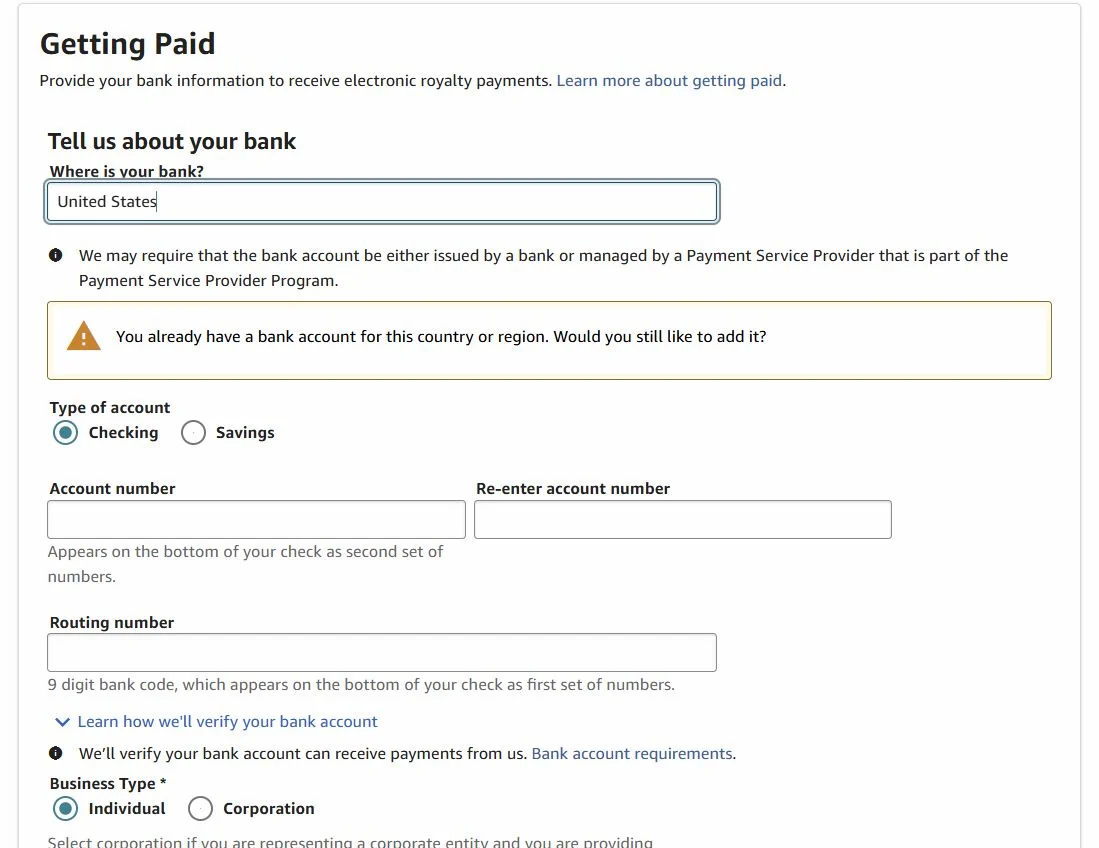
Decide this before you register, because the Getting Paid screen asks for account details right away.
KDP pays royalties to the bank account you enter in Getting Paid. It asks for an account number and bank codes, not a card number. Direct deposit (EFT), which has no minimum payment, is available for banks in these places, per KDP Payment Options (as of September 2026):
| Region | Direct deposit available for banks in |
|---|---|
| Americas | US, Canada, Brazil (checking accounts only), Mexico |
| Europe | EU countries, UK |
| Asia and Oceania | India, Japan, Australia, Hong Kong, Singapore, Thailand, Indonesia, Philippines, Pakistan, Israel |
| Africa | South Africa, Egypt, Kenya |
The list changes from time to time, so check it in Your Account → Getting Paid before you open anything.
If you live in one of these countries, a normal local bank account works. If you don't, you have two routes.
Route 1: a bank account in a listed country. KDP doesn't publish a list of approved banks. Its help page names HSBC, First National Bank and Bank of America only as examples of "a deposit-taking bank". The hard part isn't choosing a bank. It's opening an account at all, since banks usually want residency or a real reason to serve you.
Route 2: a payment service provider (PSP) from Amazon's list. This is what most authors outside the direct deposit countries use. Since August 1, 2026, Amazon pays only to PSPs in its Payment Service Provider Program, and only after the provider's know-your-customer checks are done (KDP Help: Payment Service Provider Program, as of September 2026). KDP's warning if yours isn't listed: "switch to a participating PSP or use an account which you opened directly with a deposit-taking bank as soon as possible to avoid impact to your royalties and publishing experience on KDP."
The list has 46 names. Most serve businesses in China, India or Latin America. Payoneer and Wise are on it, and those are the two individual authors use most. Revolut isn't on the list; an EU Revolut account with its own IBAN can still be used as a regular bank account.
Amazon's list is not a promise that a provider will open an account for you
This is the most common confusion. The list says which providers Amazon will pay. Whether a provider will open an account for you is up to the provider, and it depends on your country and on whether you're a person or a company. Several providers on the list only serve registered companies, and some only serve their home country. Check the provider's own sign-up terms for your country before you plan around it.
What we use: Payoneer. It opens personal accounts, it works from Ukraine, and our royalties arrive there. It gives you separate receiving details per currency (dollars for the US marketplace, pounds for the UK, euros for Europe), and you can add each one to the matching marketplace in KDP. If you'd rather split them, that works too: we've sent US royalties to one provider and UK royalties to another.
Two practical notes from our experience:
- Withdrawing from Payoneer to a local bank isn't free. For us it costs roughly $30 per $1,000. Factor that in when you look at your royalties.
- You don't always have to withdraw. The Payoneer card can go into Google Wallet or Apple Wallet and be used to pay directly.
The name on the Payoneer or Wise account must match the name in KDP letter for letter, and both must match your passport. More on the Getting Paid screen in KDP account setup.
The tax interview and the 30% withholding
You can't skip this step. Without it, you won't get paid.
In Your Account → Tax Information, answer that you're not a US person. KDP generates a W-8BEN for individuals, or a W-8BEN-E if you publish through a non-US company, and you sign it electronically. The IRS describes the W-8BEN as the form you give the payer "if you are a foreign person and you are the beneficial owner of an amount subject to withholding" (IRS: About Form W-8BEN).
What gets withheld, per KDP Tax Withholding (as of September 2026):
- "Royalty payments for eBook sales on Amazon.com and print book sales on Amazon.com, Amazon.co.jp, Amazon.com.au, and Amazon.ca are subject to 30% US tax withholding."
- If your country has an income tax treaty with the US, you may qualify for a lower rate. The treaty rates for royalties are in the IRS tax treaty tables. The interview works out the rate from your answers and shows it at the end.
- Separate rules apply on Amazon.com.br and Amazon.in. The same KDP page lists them.
You don't need a US tax number. This is the fear we hear most often. KDP accepts either a US TIN (taxpayer identification number) or "the income tax identification number issued to you by the tax authority in your country of residence." Your own country's tax number is enough to claim the treaty rate. You don't have to get an ITIN (the IRS tax number for people who can't get a Social Security number) or an EIN (a US business tax number) just for KDP.
Three more things to know:
- Your W-8 expires. "Your W-8 will expire on the last day of the third succeeding calendar year from the date signed." If you don't renew it, withholding goes back to 30%.
- Match your passport. Fill in the form from your passport, with the same spelling as in your KDP account and your payment provider. A different transliteration of your name is the most common reason we see for stuck payments.
- You'll get a Form 1042-S. KDP sends it to non-US publishers by March 15 each year (KDP Year End Tax Forms). It shows what was paid and withheld. Your accountant will want it.
Amazon only handles the US side. How your royalties are taxed at home is a separate question. Raise it with an accountant before the first payment, not after.
When the money arrives
"Royalties are paid every month, approximately 60 days after the end of the month in which the sale was reported" (KDP Help, as of September 2026). Expanded Distribution takes 90 days. Direct deposit then takes 1–5 business days. Where to track royalties before they're paid: KDP sales dashboard.
The clock starts with the sale, not with publishing. Sell your first copy in August and the money arrives around the end of October.
Paying for ads from outside the US
The account that receives royalties and the card that pays for Amazon Ads are two different things, and people mix them up all the time.
Technically any card you hold will do for ads. In practice the difference is big. In our accounts, Amazon Ads charges add up into sizable amounts. European banks and Wise regularly asked us to confirm charges of $1,000–2,000, a normal month of spend on one campaign, and local banks often did too. When we missed a confirmation, the charge failed and the campaigns stopped. By morning the book had slipped in search, and getting it back cost new money.
That's why we pay for ads with Payoneer: in our experience its card lets Amazon's charges through without confirmation requests.
And budget for it: until the first royalties arrive, about three months after launch, the ads run on your own money. Put that money aside before you publish. How much to set aside is in how much it costs to self-publish on KDP.
Language and market
The book's language decides your market, not your country. The default answer is English. It's Amazon's largest readership, and one English book sells in the US, UK, Canada and Australia at once, with ads in each. That's why the same work earns more.
Other languages aren't closed. The markets are smaller, but so is the competition, and clicks are usually cheaper than in the US, so the same budget goes further. Test it, and don't treat English-only as a rule.
Amazon's Kindle Translate (beta, by invitation) translates eBooks from English into French, German, Italian, Brazilian Portuguese and Spanish; into English it works only from French. So it won't turn a book in your language into an English one. More 2026 changes: KDP rule changes 2026.
Two things to check before a book is written:
- KDP only accepts certain languages. Check the supported languages list first. Some languages are accepted for print only. As of September 2026, for example, Ukrainian is listed as "paperback and hardcover only", and Russian isn't on the list at all.
- The language can't be changed after publishing. It's one of the fields KDP locks. The full list is in what you can't change after publishing.
Our own example: we published one children's book in four languages, Ukrainian, English, Italian and German. Across all four we sold 35 copies and earned about $175 in total. Translations don't save a book that nobody searches for. Check the niche before you write.
Logging in from abroad and VPNs
Logging in from any country is fine. Amazon doesn't block accounts by country.
What looks suspicious in our experience is constant country-hopping: a different country every day through a VPN looks like someone hiding their location. One login from a hotel on a trip is normal.
What the KDP Terms say is about people, not places: "You may maintain only one account at a time" and "You may not permit any third party to use the Program through your account" (KDP Terms and Conditions, sections 4.2–4.3, last updated September 27, 2024). A shared login used by several people in several countries breaks the second rule and also looks like a hacked account.
Our rule of thumb: one account, one person, one device, one usual network. The other reasons accounts get closed are in why KDP accounts get terminated.
What you don't need to worry about
"They'll close my account because of my country." Not in our experience. The reasons accounts get closed are the same for everyone: a second account, paid reviews, other people's trademarks in listings, data that doesn't match the ID. Nationality isn't one of them.
"I need a US company." No. You can register as an Individual with your passport. A US LLC doesn't solve the payment question, and for a non-US owner it adds an IRS filing (Form 5472) with a $25,000 penalty if you miss it. The details are in do you need an LLC for Amazon KDP.
"My English has to be perfect." Not for setup. The fields are standard, and you can translate anything unclear. Keep the site itself in English, though. Auto-translate renames the fields and leads to mistakes.
The order to do it in
- Payment provider first. Open Payoneer, Wise or a bank account in a listed country before you register. Check that the provider is on Amazon's PSP list and will serve someone in your country.
- Have your passport ready. Name, surname and address go in exactly as written there, with the same spelling at your payment provider.
- Register and do the tax interview. Steps are in KDP account setup.
- Set aside three months of ad budget. You pay for ads before the first royalty arrives.
- Only then the book. Check the niche with numbers and work out what a copy earns in the KDP royalty calculator before you pay for a manuscript or a cover.
FAQ
Can non-US residents publish on Amazon KDP?
Yes. KDP doesn't restrict authors by citizenship or residence. The differences are how you get paid, the W-8BEN tax form and possible US withholding, and which languages KDP supports.
Do I need an ITIN or EIN for KDP as a non-US author?
No. KDP accepts either a US TIN or the income tax number issued by the tax authority in your country of residence. Your own country's number is enough to claim a treaty rate.
How much tax does Amazon withhold from non-US authors?
By default 30% on royalties from eBook sales on Amazon.com and print sales on Amazon.com, .co.jp, .com.au and .ca. If your country has a tax treaty with the US, the W-8BEN can reduce the rate; the IRS tax treaty tables list the rates for royalties.
Can I receive KDP royalties with Payoneer or Wise?
Yes. Since August 1, 2026, KDP pays only to payment service providers in its Payment Service Provider Program, and both Payoneer and Wise are on the list as of September 2026. Check that the provider will open an account for someone in your country.
Do I need a US company to publish on KDP from abroad?
No. You can register as an individual with your passport. A US LLC doesn't solve the payment question, and a foreign-owned single-member LLC generally has to file Form 5472 with the IRS for each year it has reportable transactions with its owner (forming and funding it count), and the penalty for not filing is $25,000.
Royalties and ad spend per book, side by side — the way we track our own books. It also shows the highest ACOS each book can afford. Leave your email and we'll send it.
One email a week at most. Unsubscribe in one click.
Real campaign numbers, not theory. One recent case: the same keyword in two match types — broad at 9% ACOS, exact at 49%. In the Facebook group KDP Ads & Profit we break down cases like this every week.
Join the group →or follow Darya on LinkedIn

Selling books on Amazon KDP since 2023, 77,600+ copies sold. Every number in these articles comes from our own KDP and Amazon Ads accounts.
All articles