Getting started
Do you need an LLC for Amazon KDP? No, and here's when it matters
 Tap to open full size
You don't need an LLC to publish on Amazon KDP: you can register as an individual, publish under a pen name and get paid in your own name. By default a single-member LLC is taxed like a sole proprietor, and for non-US owners it adds an IRS filing, Form 5472, with a $25,000 penalty if you miss it. Below: when an LLC or a trademark actually makes sense, with official sources.
The short answer
No. You don't need an LLC (limited liability company) to publish on Amazon KDP. You can publish as an individual under your own name, with a pen name on the books, and KDP will pay you personally. Amazon never asks you to form a business.
This article is about books only. If you're asking about a company for selling products on Amazon, that's Seller Central, a different business with different rules, and we don't cover it here.
This article explains what KDP, the IRS (the US tax agency) and the USPTO (US Patent and Trademark Office) publish as of September 2026, plus our own experience. It isn't legal or tax advice. Before you form a company or file a trademark, talk to an accountant or attorney who knows your state or country.
Individual or Corporation: what KDP actually asks
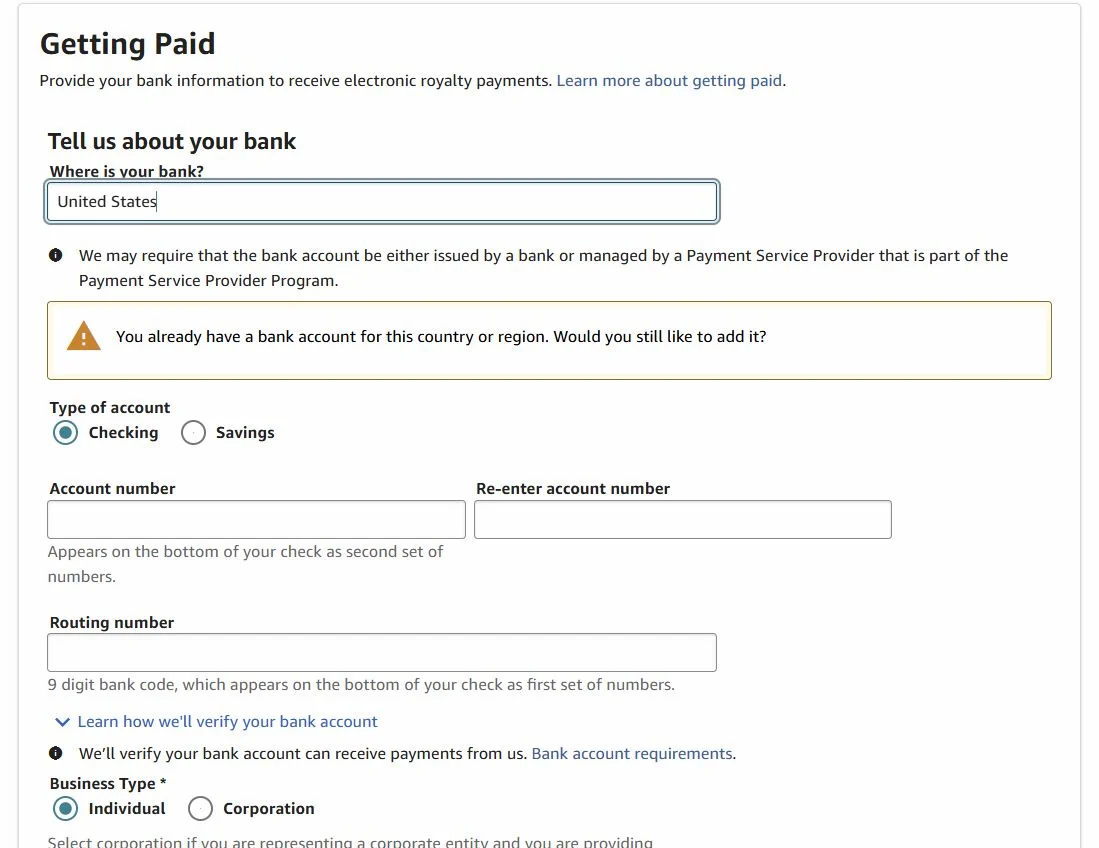
In Account Details and Getting Paid, KDP asks one question about your business: Individual or Corporation (KDP Help: Create a KDP account). Most authors starting out choose Individual.
With Individual:
- the account is in your legal name;
- your books can carry any pen name;
- royalties go to your bank account;
- in the tax interview, a US author completes a W-9 with their SSN (Social Security number), and a non-US author completes a W-8BEN (the IRS form confirming you're not a US taxpayer). The steps are in KDP account setup.
When you start thinking about a company depends on your situation, not on Amazon: how much you earn, your liability concerns, what your bank and tax office expect. Our advice: don't form anything in advance "just in case". Publish a book and see whether it sells first. A company means fees and paperwork every year, and the book may not work.
Sole proprietor vs LLC for US authors
If you're a US author publishing as an individual, the IRS treats your KDP income as business income on your personal return. A single-member LLC doesn't change that by default.
From the IRS page on single member limited liability companies (last updated July 27, 2026): "For income tax purposes, an LLC with only one member is treated as an entity disregarded as separate from its owner, unless it files Form 8832 and affirmatively elects to be treated as a corporation." And: "If the owner is an individual, the activities of the LLC will generally be reflected on: Form 1040 or 1040-SR Schedule C, Profit or Loss from Business (Sole Proprietorship)."
In plain terms: by default, a one-person LLC is taxed the same way as a sole proprietor. It doesn't lower your federal tax on its own.
| Individual / sole proprietor | Single-member LLC | |
|---|---|---|
| Needed for KDP? | No | No |
| Federal income tax by default | Schedule C | Schedule C (disregarded entity) |
| W-9 in the KDP tax interview | Your name, your SSN | Your name on line 1, LLC name on line 2, your SSN or EIN (Employer Identification Number, a business tax ID) |
| State fees | None for the business itself | Formation fee plus an annual fee in many states |
| Separates business from personal assets | No | That's the main reason people form one; how much protection you get depends on state law |
The W-9 row comes straight from the IRS Form W-9 (Rev. March 2024) instructions for a disregarded entity: "Enter the owner's name on line 1", "Enter the disregarded entity's name on line 2", and "Enter the owner's SSN (or EIN, if the owner has one)."
Reasons US authors do form an LLC: to separate business and personal money and liability, to sign contracts with ghostwriters and illustrators as a business, or to publish under an imprint name. Those are real reasons. "Amazon requires it" isn't one of them.
Non-US authors and US LLCs
People outside the US often hear that they need a US LLC for KDP, usually "in Delaware, because the tax is zero". Both parts are wrong, and the difference costs money.
A US LLC doesn't solve getting paid. KDP pays non-US individuals to banks in supported countries or to approved payment providers such as Payoneer and Wise. Since August 1, 2026 that list is strict: KDP pays only to an account opened directly with a bank or to one of 46 approved providers (Payoneer, Wise, WorldFirst, PingPong, Airwallex and others). Revolut isn't on the provider list; it works only as a regular EU bank account. See KDP rule changes 2026. You don't need a company for that. See Amazon KDP for non-US authors.
Delaware isn't zero. Delaware's own site says all Delaware LLCs "are required to pay an annual tax of $400.00", due by June 1, with no annual report required (Delaware Division of Corporations, as of September 2026). Other states differ. Wyoming's annual license tax, for example, is "$60 or two-tenths of one mill on the dollar ($.0002), whichever is greater", calculated on assets located in Wyoming (Wyoming Secretary of State). On top of that, you pay a registered agent in the state every year.
The expensive part is Form 5472. A US single-member LLC owned by a non-US person has a federal filing that cheap formation services rarely mention. From the IRS instructions for Form 5472: a foreign-owned US disregarded entity is "required to file a pro forma Form 1120, U.S. Corporation Income Tax Return, with Form 5472 attached". Reportable transactions include "amounts paid or received in connection with the formation, dissolution, acquisition, and disposition of the entity, including contributions to, and distributions from, the entity". So an LLC that earned nothing can still have to file. The penalty: "A penalty of $25,000 will be assessed on any reporting corporation that fails to file Form 5472 when due and in the manner prescribed."
Budget for an accountant who handles foreign-owned US LLCs from day one, not "later". And the LLC doesn't replace your tax obligations at home.
Do you need a trademark for KDP?
For publishing on KDP, no. KDP doesn't ask for a trademark anywhere, and you can publish and sell without one.
What you already have without filing anything:
- Copyright in your text. The US Copyright Office says "Publication is not necessary for copyright protection": the work is protected once it's created and fixed (Copyright Office FAQ). Registration isn't required, but it gives you more options if you have to enforce your rights.
- But not your title. The same FAQ: "Copyright does not protect names, titles, slogans, or short phrases." Two books with the same title on Amazon aren't an infringement.
When a trademark can matter
A series name or an imprint. The USPTO won't register the title of a single book: "Your trademark won't register if it's only used as the title of a single creative work." A series name can register: "If your trademark is the name or title of a series of creative works, it may register." Its examples include the Chronicles of Narnia (USPTO, last updated March 12, 2024). If you're building a long series or a publishing brand that other people might copy, that's when to look into it. The USPTO base application fee is "$350" per class of goods or services (USPTO: How much does it cost?, as of September 2026), plus possible extra fees and an attorney if you use one.
Amazon Brand Registry. Brand Registry needs "a pending or registered trademark for your brand name or logo" from a government trademark office. Its requirements also mention "a logo that includes your brand name permanently affixed to your products or packaging" (Amazon Brand Registry, as of September 2026). It's built for product brands sold through Seller Central. Amazon's Brand Registry pages don't describe a books-specific program. If Brand Registry is your only reason to file a trademark, ask Brand Registry support how it would apply to your KDP books before you pay for one.
Other brands in your listing. This matters for every author, with or without a trademark. KDP's keyword guidelines rule out "Brands that you do not own or that you are unauthorized to use" and "the name of an author not associated with your book", and KDP says it has "a zero tolerance policy for metadata that is meant to advertise, promote, or mislead" (KDP Help: keywords). The same goes for covers: other companies' logos, characters and film stills are how accounts get into trouble. More in why KDP accounts get terminated and Amazon KDP keywords.
What's worth doing before you publish: search Amazon for your title so you don't launch right next to someone else's bestseller with the same name.
What to do today
- Complete the tax interview under Your Account → Tax Information. A US author needs an SSN, and a non-US author can use their own country's tax number.
- Set up Getting Paid with a bank account, or a provider from KDP's approved list if you're outside the direct deposit countries.
- Don't register a company or a trademark in advance. Publish, look at the sales, and come back to this when there's money to protect. Before that, check what each copy will actually earn in the KDP royalty calculator.
FAQ
Do I need an LLC to publish on Amazon KDP?
No. KDP lets you register as an individual. Your books can carry a pen name, and royalties are paid to you personally. Amazon never requires you to form a business.
Does an LLC save taxes on KDP royalties?
Not by default. The IRS treats a single-member LLC as a disregarded entity unless it elects corporate treatment, so its income generally goes on the owner's Schedule C, the same as a sole proprietor.
How do I fill in the KDP tax interview with a single-member LLC?
Per the IRS Form W-9 instructions for a disregarded entity, the owner's name goes on line 1, the LLC's name on line 2, and the TIN is the owner's SSN, or EIN if the owner has one. Check with your accountant for your case.
Should a non-US author form a US LLC for KDP?
Usually not for KDP alone. It doesn't solve getting paid, states charge annual fees (Delaware's LLC tax is $400 a year), and a foreign-owned single-member LLC must file Form 5472 with a pro forma Form 1120, with a $25,000 penalty for not filing.
Do I need a trademark to publish on KDP?
No. Your text is protected by copyright from the moment it's created, and book titles can't be copyrighted. A trademark can make sense for a series name or an imprint; the USPTO won't register the title of a single book.
Royalties and ad spend per book, side by side — the way we track our own books. It also shows the highest ACOS each book can afford. Leave your email and we'll send it.
One email a week at most. Unsubscribe in one click.
Real campaign numbers, not theory. One recent case: the same keyword in two match types — broad at 9% ACOS, exact at 49%. In the Facebook group KDP Ads & Profit we break down cases like this every week.
Join the group →or follow Darya on LinkedIn

Selling books on Amazon KDP since 2023, 77,600+ copies sold. Every number in these articles comes from our own KDP and Amazon Ads accounts.
All articles