Case studies
Video ads for books on Amazon: are they worth it in 2026
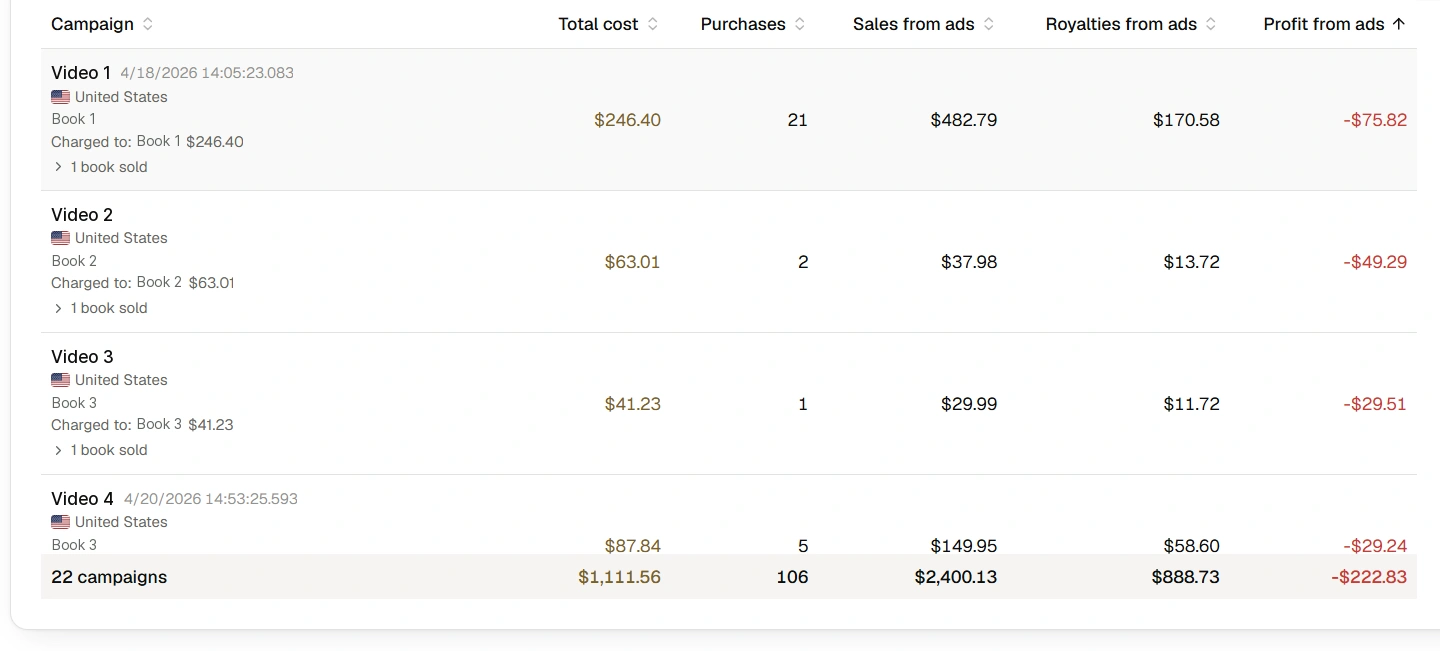
Video ad clicks are cheaper, but fewer people buy — so video doesn't always pay. We went through 127 video campaigns on four of our accounts, almost $88,000 in spend: the older ones bought a sale for $6 and were the best in the account, the new 2026 ones for $12.60–13.20 against $7–10 in royalties per copy. Below are the numbers and how to check yours.
The short answer
- Video ads don't always pay. Some of our video campaigns bought a sale for $6, others for $13 — against $7–10 in royalties per copy.
- Video clicks are cheaper, but fewer people buy. So don't judge by cost per click, or even by ACOS (ad spend as a share of ad-attributed sales), but by the cost of one purchase.
- In 2026 video got more expensive for us. Clicks rose 30–50%, the share of clickers who bought fell 20–40%, and video became costlier than regular ads.
- Judge each video campaign on its own. The average across all videos hides both the best campaigns in the account and the worst.
Seven numbers in Amazon Ads that show whether the ads are earning or just running. Leave your email and we'll send it.
One email a week at most. Unsubscribe in one click.
What video ads for books are
Video ads for books are part of Sponsored Brands. KDP Help describes the format like this (as of September 2026): Sponsored Brands lets you "run eye-catching video ads that direct shoppers to a detail page" (KDP Help). Authors got the format on December 6, 2023, together with multi-book ads (Amazon Ads).
What to know before you launch:
- You pay per click, not per view. "Authors only pay when a shopper clicks on their ad" (Amazon Ads).
- Placement bid adjustments don't apply to video. Amazon's Sponsored Brands guide for authors says "automatic bidding or bid adjustments will not be applied to ads with video ad format" (Amazon Ads). The top-of-search percentages from our placements guide don't touch video: a video ad has one bid.
- Sales are credited the same way as regular ads: within 14 days of the click.
Our numbers: 127 video campaigns on four accounts
We exported every campaign from Amazon Ads over the accounts' lifetime and split them into groups: video created before 2026, video from 2026, and regular Sponsored Products campaigns from 2026. Below are the two largest accounts. "Bought" is the share of clickers who bought the book; "cost per purchase" is what one sale cost in ads.
Account A
| Campaigns | Spend | Cost per click | Bought | Cost per purchase | ACOS |
|---|---|---|---|---|---|
| Video, pre-2026 | $34,322 | $0.63 | 10.4% | $6.02 | 31.2% |
| Video, 2026 | $11,375 | $0.83 | 6.3% | $13.24 | 61.7% |
| Regular, 2026 | $8,572 | $1.10 | 11.1% | $9.93 | 45.3% |
Account B
| Campaigns | Spend | Cost per click | Bought | Cost per purchase | ACOS |
|---|---|---|---|---|---|
| Video, pre-2026 | $16,489 | $0.58 | 8.8% | $6.57 | 33.8% |
| Video, 2026 | $11,996 | $0.88 | 6.9% | $12.64 | 55.4% |
| Regular, 2026 | $17,007 | $1.13 | 12.4% | $9.10 | 37.7% |
Two more accounts point the same way: on account C, 2026 video ran at 73.2% ACOS against 46.3% for regular campaigns of the same year; on account D, 43.8% against 41.8%.
One caveat: "pre-2026 video" means campaigns created earlier, but some of them still run, so their totals include months of 2026. The comparison isn't "2025 vs 2026" but "old campaigns vs new ones."
People also click new videos less often: click-through rate fell from 1.19% to 0.35% on account A and from 0.90% to 0.47% on account B.
What the tables show:
- Old video campaigns are the best in the account. A sale for $6 is cheaper than regular campaigns on average. The best of them reached 19–26% ACOS.
- New video campaigns are the worst. Clicks cost 30–50% more, people click two to three times less often, and 20–40% fewer clickers buy. A sale costs $12.60–13.20.
- Regular campaigns hold up. Their clicks are the most expensive, but more clickers buy than anywhere else, and a sale costs $9–10.
The number that matters: cost per purchase
Video almost always has the cheapest click, and that's misleading. Money comes from purchases, not clicks, and the cost of a purchase is simple:
Cost per purchase = ad spend ÷ purchases. Or equally: cost per click ÷ share of clickers who buy.
From the table: a $0.83 click with 6.3% of clickers buying is $0.83 ÷ 0.063 = $13.17 per purchase. A $1.10 click at 11.1% is $9.91. The expensive click turned out cheaper than the cheap one.
Then compare it with what one copy earns. On these accounts a paperback brings $7–10 in royalties on average. So:
| One purchase costs | Royalty per copy $8 | Each sale |
|---|---|---|
| $6 | $8 | +$2 |
| $10 | $8 | −$2 |
| $13 | $8 | −$5 |
Every sale from the new video campaigns lost a few dollars.
What one copy earns in your case, and at what price and ACOS ads still pay, is in our KDP royalty calculator.
Why the Amazon Ads console doesn't show this
The console shows ACOS — ad spend as a share of "sales." But it counts sales at list price, while the author gets only the royalty. A video campaign at 55% ACOS looks "slightly above normal" in the console, while each of its sales actually earns less than it costs.
Here's our video campaign for September 1–24, 2026 — it's the image at the top of this article. In the Amazon Ads console: $206.91 in sales on $128.74 spent, so the ads seemingly "paid back" with room to spare. In royalties: $79.39. The result: −$49.35 in three weeks on one campaign.
One more thing: the Amazon Ads console doesn't tie video and brand ads to a specific book. If you track profit per book in a spreadsheet, that spend is easy to lose (what KDP and Amazon Ads show on their own: KDP sales dashboard) — and the book looks more profitable than it is.
When to keep a video campaign and when to switch it off
The decision is the same as for a regular campaign, just with more careful math:
- Find the book's break-even: royalty per copy ÷ list price. A $22.99 book earning $9.72 has a 42% break-even ACOS. Details in Amazon Ads for authors: judge campaigns by profit, not ACOS, or use the break-even ACOS calculator.
- Compare the video campaign's ACOS with that line. Below it, the campaign makes money and can be scaled. Above it, every sale loses money.
- Check the cost per purchase. It should be below the royalty per copy. If it's higher, the video brings people who watch but don't buy.
- Don't judge by the average. Some of our 2026 videos ran at 22% ACOS. Switching off every video would lose those too.
On our two largest accounts, of 83 video campaigns that spent more than $50, 56 were above break-even and 27 below. The second group is smaller, but the most profitable campaigns in both accounts are in it.
This is how it looks in AuthorLens: the AI assistant names the month's biggest cost — a video campaign — and what to do about it.

By hand or with a tool
By hand, it's a campaign export from Amazon Ads, royalties from KDP and a spreadsheet matching each video campaign to its book. Monthly is doable; daily isn't.
We do it in AuthorLens, an analytics dashboard made only for Amazon KDP. We use AuthorLens daily and have a business relationship with it. It counts video and brand ads in each book's profit, shows every campaign's result in royalties rather than "sales," and Ad Coach suggests which bid to lower and what that's worth in dollars — for the campaign above, from $0.84 to $0.52. The honest downsides: it covers Amazon only, and for now it only reads your data — you apply the fixes yourself; one-click fixes and an autopilot are coming soon, as options you choose.
Don't want to deal with ads yourself? Campaign setup and ongoing management can be handed to an ads specialist we trust — message him on Telegram @Lamgr_557359.
Connect your ads and royalties — the last three months arrive within minutes. You'll see which video campaign makes money, which loses it, and what Ad Coach suggests changing. $39.99 a month, cancel anytime.
Try AuthorLensFor now AuthorLens only reads your data: it doesn't change bids or campaignsFAQ
What ads can authors run on Amazon?
Sponsored Products — ads in search results and on product pages — and Sponsored Brands, which covers multi-book ads and video ads. Both are pay-per-click. Amazon also offers Display campaigns; we don't run them for books.
Are video ads for books worth it?
It depends. Our older video campaigns bought a sale for $6 at 31–34% ACOS; the new 2026 ones cost $12.60–13.20 per sale at 55–62% ACOS. Work out the cost of one purchase and compare it with your royalty per copy.
How much does a click cost in Amazon video ads for books?
For us in 2026, $0.83–0.88, against $1.10–1.13 for regular campaigns. But fewer video clickers buy, so one purchase ends up costing more.
Do placement bid adjustments work on video ads?
No. Amazon's Sponsored Brands guide for authors says automatic bidding and bid adjustments are not applied to ads with the video format.
How do I know a video campaign is losing money?
If its ACOS is above the book's break-even (royalty ÷ list price), or one purchase costs more than the royalty on one copy.
Royalties and ad spend per book, side by side — the way we track our own books. It also shows the highest ACOS each book can afford. Leave your email and we'll send it.
One email a week at most. Unsubscribe in one click.
Real campaign numbers, not theory. One recent case: the same keyword in two match types — broad at 9% ACOS, exact at 49%. In the Facebook group KDP Ads & Profit we break down cases like this every week.
Join the group →or follow Darya on LinkedIn

Selling books on Amazon KDP since 2023, 77,600+ copies sold. Every number in these articles comes from our own KDP and Amazon Ads accounts.
All articles