Tools compared
Publisher Champ vs AuthorLens: which to choose
Publisher Champ and AuthorLens are the two leaders among tools that show a book's profit after ads. We connected both to the same book: the numbers matched to the dollar, but from there the tools show very different things. Below: a comparison table, a real-book example and who each one suits.
The short answer
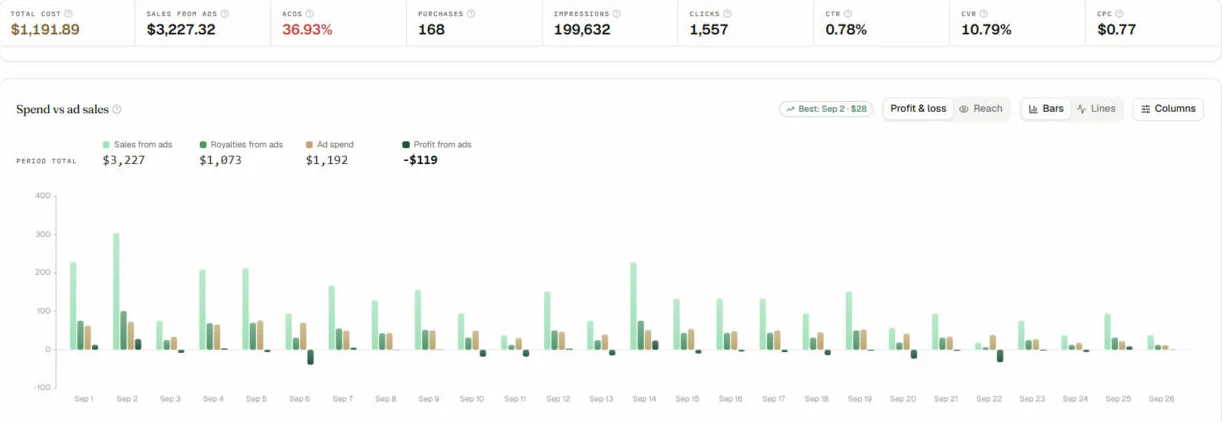
If you sell on many stores, choose Publisher Champ. If most of your money comes from Amazon and you run ads, choose AuthorLens. Both count honestly: we connected them to the same account, and for September 1–26, 2026 both showed the book earned about $730 after ads. But only AuthorLens noticed that the ads themselves were $119 in the red inside that total — and showed where.
We use AuthorLens daily and recommend it. Below: why these two made the final, how they differ, and who each one suits.
Why only these two made the final
For our tracker comparison, in September 2026 we connected every tool that promises to show profit per book after ads to our own KDP and Amazon Ads accounts, and checked every number against Amazon.
- Publisher Champ and AuthorLens matched Amazon to the cent.
- Book Report got royalties right, but Amazon ads never showed up in our reports — even though the connection went through.
- ScribeCount showed zero sales overnight after we connected KDP.
Two more tools everyone knows by name aren't about tracking an author's money:
- Helium 10 is built for sellers of physical products and doesn't connect to KDP. More in our Helium 10 for KDP review.
- Publisher Rocket helps you research keywords and niches before you publish, but it doesn't see your royalties or ad spend and doesn't follow the book after launch. More in our Publisher Rocket review.
So the real choice is between two.
At a glance
| Publisher Champ | AuthorLens | |
|---|---|---|
| Price per month | $16.99 / $21.99 / $29.99 | $39.99, or $32.99 billed yearly |
| Free trial | 14 days, no card | No |
| Stores | 25+: KDP, Kobo, Apple Books and more | Amazon only, 23 marketplaces |
| Profit per book after ads | Yes | Yes |
| Accuracy in our test | To the cent | To the cent |
| Profit of the ads themselves | No | Yes |
| Campaigns, keywords, search terms | No, ads as a book total | Yes |
| What to change in your ads | No | Ad Coach with a dollar estimate |
| Keyword rankings | No | Up to 500 keywords daily |
| Niches and competitors | No | Yes, included |
| Alerts for blocked books and rejected ads | Didn't find any | Telegram: daily report, spend limit, blocks |
| AI assistant | Luna via ChatGPT and Claude, Ultra plan | Answers from your numbers: connects to your own Claude or ChatGPT, no extra plan needed |
| Phone | iPhone, Android and Mac apps | In your phone's browser |
| Past months of ad data | Automatic only from July 2026 | 3 months in minutes |
One book in both tools
We connected both tools to one account with one book and compared September 1–26, 2026.
| Publisher Champ | AuthorLens | |
|---|---|---|
| Royalties | $1,914.64 | $1,921.97 |
| Ad spend | $1,187.70 | $1,191.89 |
| Net per book | $726.94 | $730.08 |
| Ad clicks / orders | 1,551 / 168 | 1,557 / 168 |
| ACOS | 36.80% | 36.9% |
The few-dollar gap is because we checked Publisher Champ a day earlier, while Amazon was still filling in the latest sales. Both tools count honestly. The question is what they show next.


What only AuthorLens saw
The ads were $119 in the red
The book was $730 in profit — and Publisher Champ stops there. AuthorLens separately counts what the ads themselves brought in: royalties from ad sales were $1,073, while the ads cost $1,192. The ads lost $119. Organic sales — the ones that came without ads — carried the book.
The tricky part: the same Publisher Champ table shows "AMS ROI 171%" — as if the ads nearly tripled their money. But that's calculated from list price, from $3,227 in "sales." Publisher Champ says the ads returned 171%. AuthorLens calculates from your royalties — and finds minus $119.
That's the key question for any author running ads: do the ads pay for themselves, or do they just buy orders that would have come anyway?
Which campaign eats the money
Ad Coach found 4 fixes for this book. One is a video campaign at 69% ACOS against a 36.8% break-even: Amazon reports "$208.89 in sales," but the royalty on that is about $77, while the campaign cost $144.97. The advice is specific: bring the bid down from $0.66 to $0.35 a click, or pause the keywords that spend without converting.
The other three are about keywords that sell "by accident": shoppers arrived through 12 different keywords, and Ad Coach suggests adding those searches as exact-match keywords so you control the bid yourself.

The price difference between the two tools is $23 a month. This one Ad Coach fix on this book is estimated at about $78 a month.
Ad Coach amounts are the tool's estimate, not a promise. AuthorLens doesn't change bids itself: you decide and make the changes in Amazon Ads.
And the rest — on our other account
This is a different book from the one above: on our second account, in the same week of testing, AuthorLens found a few more things a tracker doesn't show:
- A suspended ad. Amazon stopped an ad in one campaign for a policy violation. In Amazon Ads you only see it if you open the campaign, the ad group and click "Details." AuthorLens showed it on the Issues screen and sends problems like this to Telegram.
- Keyword rankings every day — where the book sits in search, organic and sponsored.
- A daily Telegram report, at a time you choose: for September 24 — 4 sales, all without ads, while the ads spent $19.33 and sold nothing. In KDP that day looks like "four sales, all good."
- The AI assistant: asked "where am I losing money on ads," it named three leaks and what to do about each.


Where Publisher Champ is stronger
To be fair:
- Cheaper: from $16.99 a month vs $39.99.
- A free trial — 14 days, no card. AuthorLens doesn't offer one.
- Many stores. If you sell on Kobo, Apple Books, through libraries or your own store, Publisher Champ puts it all in one dashboard. AuthorLens only sees Amazon.
- Phone apps. AuthorLens works in your phone's browser; there's no separate app.
- Faster first load: it pulls only the last month first. But past ad data is automatic only from July 2026 — anything earlier you import by hand.
Where AuthorLens is stronger
- It counts the profit of the ads themselves, not just the book — and shows when ads are losing money while the book is in profit.
- It breaks ads down to campaign, keyword and shopper search term. Publisher Champ shows a total per book.
- It tells you what to change: Ad Coach with an exact bid and a dollar estimate.
- Rankings for up to 500 keywords daily, niches and competitors — in the same subscription.
- It warns you: a Telegram report, an ad spend limit, a blocked book or a rejected ad.
Who each one suits
You sell on many stores and your Amazon ads are small. Publisher Champ: one dashboard for everything, and cheaper.
Most of your money comes from Amazon and ads are a real expense. AuthorLens: it shows whether the ads pay off and what to change.
Many stores and serious Amazon ads. Use both: Publisher Champ for totals across stores, AuthorLens for Amazon ads. They barely overlap.
Just starting, no ads yet. Our free royalty and profit calculator is enough for now. Once you start ads, AuthorLens shows right away whether they pay off.
Our take
Both tools count money honestly — in our test they matched Amazon and each other. Pick the one that fits your business. We chose AuthorLens: it doesn't just show what the book earned, it finds where the ads lose money and what to do about it.
FAQ
Publisher Champ or AuthorLens — which is better?
It depends on where you sell. Many stores and small ads — Publisher Champ: cheaper and covers 25+ stores. Most money from Amazon and meaningful ad spend — AuthorLens: it shows the profit of the ads themselves, campaigns and keywords, and what to change. We use AuthorLens.
Which one is more accurate?
Both. On one book for September 1–26, 2026, Publisher Champ showed $1,914.64 in royalties and $1,187.70 in ad spend; AuthorLens showed $1,921.97 and $1,191.89. The gap is days Amazon was still filling in.
How much do Publisher Champ and AuthorLens cost?
Publisher Champ is $16.99, $21.99 or $29.99 a month with a 14-day free trial, no card. AuthorLens is $39.99 a month or $32.99 billed yearly, no free trial.
Does Publisher Champ show ads by campaign?
No. It includes Amazon ads, video too, but shows them as a total per book. Campaigns, keywords and shopper search terms are visible in AuthorLens.
Can I use both?
Yes. Publisher Champ for totals across all stores, AuthorLens for Amazon ads. They barely overlap.
What about Book Report, ScribeCount, Helium 10 and Publisher Rocket?
In our test Book Report didn't show ads and ScribeCount didn't show a single sale. Helium 10 is built for product sellers and doesn't connect to KDP; Publisher Rocket researches keywords before publishing and doesn't see an author's money.
Royalties and ad spend per book, side by side — the way we track our own books. It also shows the highest ACOS each book can afford. Leave your email and we'll send it.
One email a week at most. Unsubscribe in one click.
Real campaign numbers, not theory. One recent case: the same keyword in two match types — broad at 9% ACOS, exact at 49%. In the Facebook group KDP Ads & Profit we break down cases like this every week.
Join the group →or follow Darya on LinkedIn

Selling books on Amazon KDP since 2023, 77,600+ copies sold. Every number in these articles comes from our own KDP and Amazon Ads accounts.
All articles